
The short version: For a Fukuoka trip from Busan with a 3-year-old, fly on the way there and take the New Camellia ferry back. You board with your luggage in hand, no liquid screening, and your child spends six hours in an open cabin instead of a seat. Book on the Japanese official site in yen and you can pay roughly half of the standard fare for the same sailing.
Last October we took our three-year-old daughter from Busan to Fukuoka. We flew out of Gimhae and came home on the New Camellia from Hakata Port. People keep asking why on earth we would put a toddler on a six-hour ferry. The honest answer is that those six hours were the most relaxed part of the whole trip.
This is a record of what we actually booked and how the day went: the real payment breakdown, the check-in cut-off times, the difference between the 2nd-class and 1st-class rooms, and the bus from Hakata Station to the port. Fares reflect the revision that took effect on October 1, 2026, and all prices were checked on November 6, 2026.
1. Why flying out and sailing back works with a toddler
With small children, the thing that decides how tired everyone gets is not the sightseeing. It is the transfer. A three-year-old is at an awkward age: strap them into a stroller and they fall asleep, let them out and they run. So we did not force the whole trip onto one mode of transport. We chose differently for each direction.
Outbound by plane: to keep the first afternoon
Gimhae International Airport to Fukuoka Airport is about 55 minutes in the air. From the airport it is two subway stops and five minutes to Hakata Station. Leave in the morning and you are standing in Canal City or Tenjin by lunch. On a short trip with a toddler, having that first afternoon intact is worth more than it sounds.
Return by ferry: because your child is not strapped in
The real advantage of the ferry is not the schedule. It is the space. On a plane, a three-year-old has to stay in a seat for 55 minutes. On the ship, our daughter moved between the cabin, the observation salon and the deck for six hours, then wore herself out and fell asleep on her own. Rolling around on tatami and carpet is a completely different experience from working through a bag of snacks in seat 14C.

Fly out, sail back: the combination we actually used with a three-year-old.
Luggage: no liquid rules, no scale
Travel with a child and your luggage doubles: nappies, wipes, formula, snacks, spare clothes, a stroller. Flights bring the 100 ml liquid limit and a checked-baggage weight allowance. The ferry does not. You wheel your suitcase aboard and leave it in your cabin, and nobody screens your liquids. Being able to buy souvenirs without worrying about the extra kilo was the most satisfying part of the trip.
If you would rather not carry everything, there is a checked-baggage service: 800 yen (8,000 won) per piece up to 20 kg, then 300 yen (3,000 won) for each additional 10 kg. Note that some sailings, including the overnight departure from Busan, do not offer checked baggage, so plan to carry your own bags on those.
Strollers: expect the stairs
You can bring a stroller as long as you fold it. There is only one lift on board, though, and it gets busy at boarding and disembarkation. We folded ours and carried it, with one of us on the suitcase and the other on the child. When leaving the ship, send the bags out first and bring the child last; it is much calmer that way.
2. New Camellia schedule and check-in times
The New Camellia is the only scheduled passenger ship between Busan and Hakata in 2026. The old high-speed jets (the Beetle and Queen Beetle) no longer run, so ignore older blog posts that still mention them. Korea Ferry handles bookings and tickets on the Korean side; Camellia Line handles the Japanese side.
| Step | Busan → Hakata | Hakata → Busan |
|---|---|---|
| Check-in / ticket issue | 16:30–18:30 | 10:30–11:30 |
| Immigration | 19:00–19:30 | 11:00–12:00 |
| Boarding complete | 19:40 (by 20:00) | 12:10 |
| Departure | 22:30 | 12:30 |
| Arrival | 07:30 next morning | 18:30 |
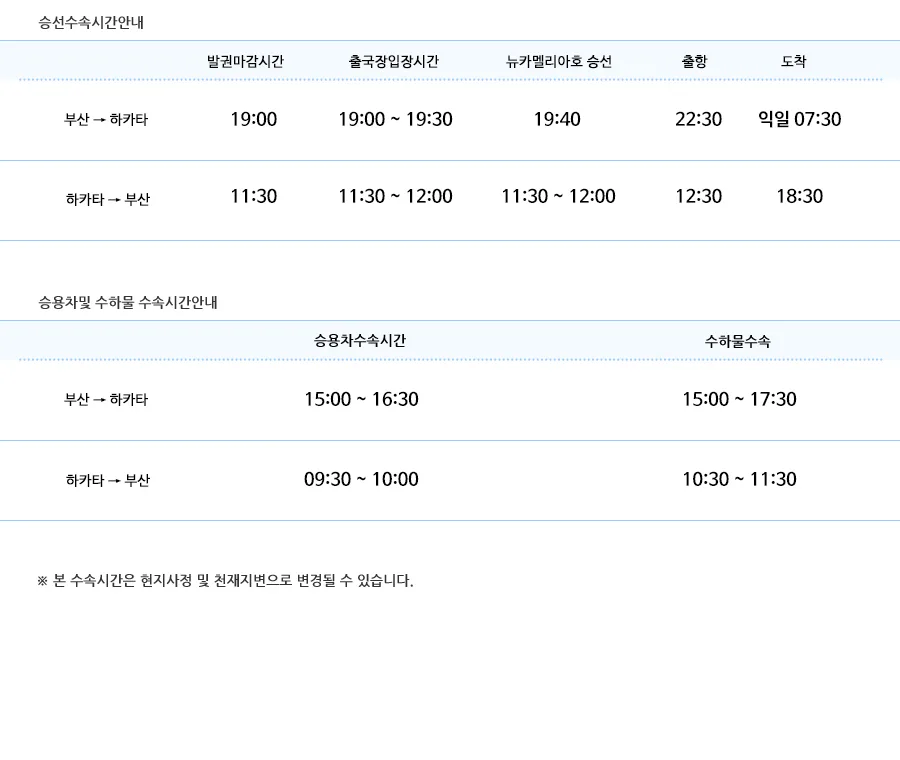
The boarding timetable posted at the terminal and in your booking. Note the 11:30 ticket cut-off for the Hakata departure.
The detail that catches people out is the 11:30 ticket cut-off for the Hakata departure. The ship sails at 12:30, so you must be done an hour before. With a child, the bus from Hakata Station takes 20 minutes and you want another 30 for the counter and sorting out your bags. We caught a bus around 10:40, reached the terminal just after 11:00, and had exactly enough time. Leave at 11:00 instead and you will be running.
3. 2nd class or a 1st-class tatami room?
On the New Camellia you are not choosing a seat. You are choosing a room. One-way fares under the October 1, 2026 revision are below.
| Cabin | Adult, one-way | Child 2–5 | What it is |
|---|---|---|---|
| 2nd class, open room | ₩150,000 / ¥15,000 | ₩30,000 / ¥3,000 | Shared carpeted room, no assigned space |
| 2nd class, bunk | ₩170,000 / ¥17,000 | ₩50,000 / ¥5,000 | Curtained bunk, best for night crossings |
| 1st class, tatami or western | ₩210,000 / ¥21,000 | ₩90,000 / ¥9,000 | Private room with a door, best with kids |
| Deluxe twin | ₩280,000 / ¥28,000 | ₩160,000 / ¥16,000 | Hotel-style with shower and toilet |
| Special room | ₩330,000 / ¥33,000 | ₩210,000 / ¥21,000 | Private deck; travel agents only |
Children under two travel free, one per accompanying adult. Round-trip and student discounts were abolished on September 30, 2026, so a return trip is simply twice the one-way fare. Those figures are the fare only; fuel surcharge, departure tax and terminal fees come on top (more on those below).
We booked 2nd class
We took the 2nd-class open room for two reasons. First, we were sailing at 12:30 in the afternoon, so nobody needed to sleep. Second, our daughter was not going to stay in one spot anyway, and a big open room suited that better than a small private one. On a daytime crossing, 2nd class is the best value on the ship. You cannot reserve a particular spot, but it was not crowded and we found space by the windows.
The calculus changes completely for the 22:30 overnight departure from Busan. 2nd class means lying on the floor in a shared room, and a toddler who wakes at every footstep and door in the night is a miserable toddler. If you take the night sailing, pay for the curtained bunks or a 1st-class room.
Next time, the 1st-class tatami room
With a bit more budget, the 1st-class Japanese room is the right answer. It is a tatami room for three to five people with a door that closes, a low table, a TV and a washbasin, and the operator itself lists it as the recommended cabin for families with children. The deciding detail is how the room charge works: three people in a four-person 1st-class room pay no supplement, while three people in a five-person room add ¥9,000 (₩90,000). For two adults plus a toddler, ask for the four-person room and save the supplement.
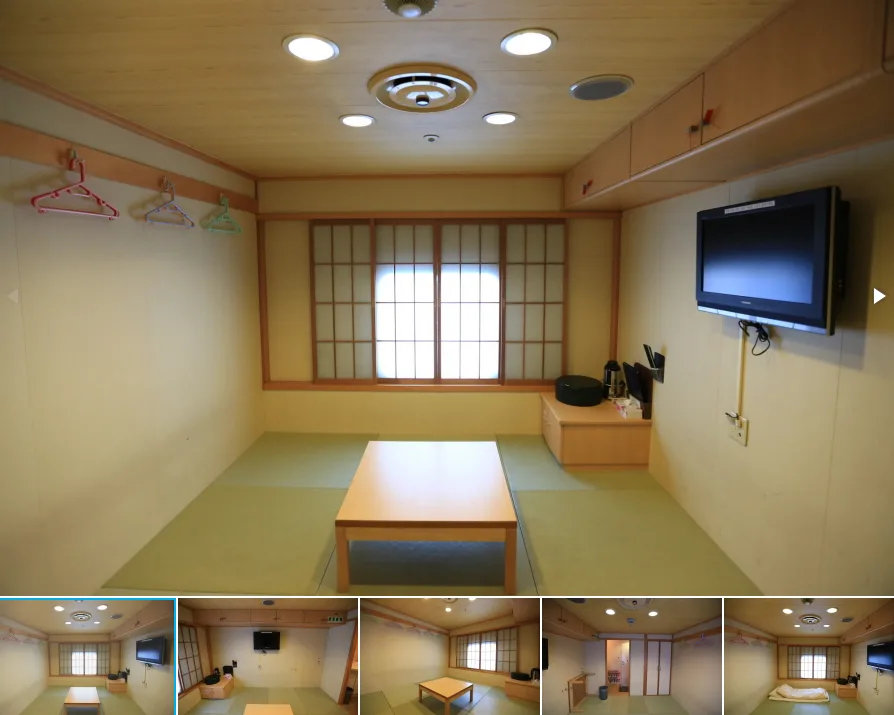
A 1st-class tatami room: a door that closes, and floor space for a toddler to roll around on.
4. How to book the same ship for about half price
Same ship, same date, and the price depends heavily on where you book. Start with the list price: the 2nd-class adult fare is ₩150,000 on the Korean site and ¥15,000 on the Japanese one. At the exchange rate on November 5, 2026 (100 yen = 850 won), ¥15,000 is about ₩127,500, so booking in yen already saves roughly 15%.
The real saving comes from the limited discount tickets the Japanese site lists alongside the standard fares, such as “2等バーゲン” (2nd class bargain). One was available on our date.
| Our booking, Hakata → Busan (2 adults + 1 toddler) | Amount |
|---|---|
| 2nd class bargain, 2 adults at ¥6,000 | ¥12,000 |
| 2nd class bargain, 1 infant at ¥2,400 | ¥2,400 |
| Fuel surcharge, 3 passengers | ¥5,100 |
| International tourist tax, ¥3,000 × 3 | ¥9,000 |
| Hakata terminal fee, 2 adults | ¥1,000 |
| Total | ¥29,500 |
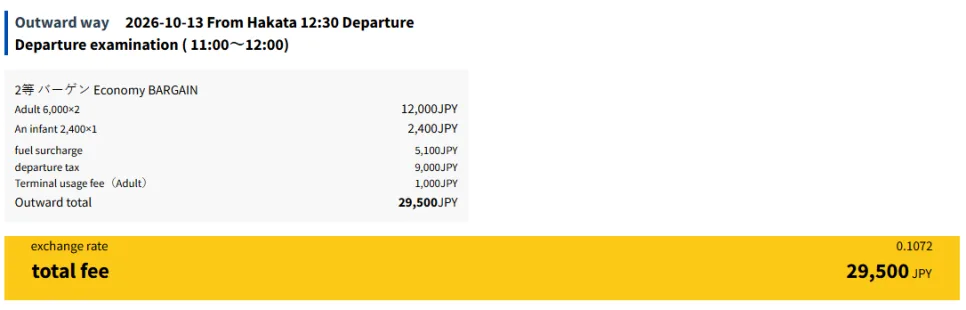
The actual booking total: a bargain fare brought a family of three to ¥29,500 one-way.
That ¥29,500 is roughly ₩250,000 at 850 won per 100 yen for two adults and a three-year-old, one way. The list price for the same three would be ₩150,000 × 2 plus ₩30,000, so ₩330,000, before surcharges and taxes push it past ₩400,000. The bargain tickets are limited in number, so check as soon as your dates are fixed.
How to book it
- Go to the Camellia Line official site (camellia-line.co.jp). Chrome’s translate function is enough if you do not read Japanese, and there is an English version.
- Choose the departure, the date and the number of passengers, then one-way or return. Bookings open six months ahead, on the same calendar date.
- Pick a cabin class. The screen shows the discount fares alongside the standard ones; take the discount if one is there.
- Sign up for an account for an extra discount. You can also book as a guest.
- Pay by card. Load yen onto a travel money card first (a Travel Wallet or Travelog card) and the charge comes straight out of your yen balance with no foreign transaction fee, saving you the conversion spread as well.
- After booking, you can look the reservation up with your booking number, date and date of birth. Print it and take it to the counter.
Two cautions. If you book a Busan departure on the Japanese site, the fare is converted at that month’s rate and charged in yen. And cancellation terms differ by booking channel: a few hundred yen until eight days out, 10% from seven to three days, 30% from two days to the day before, and up to 100% on the day. With a toddler, whose condition can change overnight, read those terms before you pay.
5. Making six hours on board count
We left Hakata at 12:30 and reached Busan at 18:30. I had assumed we would be looking for ways to fill the time. We ran out of it instead.
The observation bath
There is a bath on board with a view of the sea. With a small child it is easier to take turns than to go in together: one adult watches the kid while the other soaks. Opening hours during the crossing are announced after departure, so listen for them.
Restaurant, shop, duty-free, games
The ship has a restaurant serving Korean food, a shop and vending machines, a duty-free store, a game corner, an observation salon and a karaoke room. We ate lunch on board. We also packed our own snacks for our daughter, but between the shop and the vending machines you will not go hungry. The game corner turned out to be the best way to burn twenty minutes with a three-year-old.
The deck as you come into Busan
The last stretch into Busan passes between two bridges, and in November the sun is already going down. We spent the final half hour on deck showing our daughter the ship and the gulls. It is the part of the trip she still talks about.
If seasickness is a worry
A car ferry rolls far less than the old high-speed jets. Winter swells can still move it, though. Children’s motion sickness medicine works best given 30 to 60 minutes before boarding, and the middle of the ship on a lower deck moves least. Long spells on deck can make nausea worse, so keep a toddler inside where the movement is smaller.
6. From Hakata Station to Hakata Port
The international terminal is not far from Hakata Station, but it is not a walk. Ten minutes by taxi, about twenty by bus.
- Bus: from the Hakata Station Nishitetsu City Bank stop (platform F), take the 88 or the BRT articulated bus to the terminus, Hakata Port International Terminal. About 20 minutes, ¥260 for adults.
- BRT warning: the BRT takes no cash. You need a transport IC card (nimoca, Suica and the like) or contactless credit card. Have it out before you board with a child in tow.
- Taxi: about ten minutes, and the easier option with luggage and a toddler.
At the terminal, show your booking and passport at the Camellia Line counter and collect your ticket. Then comes immigration (11:00–12:00), boarding (complete by 12:10) and departure at 12:30. On arrival in Busan, disembarkation starts at 18:30 and the covered walkway to Busan Station takes 10 to 15 minutes on foot. If you are catching a KTX, leave at least 30 minutes after you get off the ship.
7. Flight versus ferry, side by side
| Factor | Flight (Gimhae–Fukuoka) | New Camellia (Hakata–Busan) |
|---|---|---|
| Journey time | About 55 minutes, plus airport time | About 6 hours |
| Adult one-way | From around ₩50,000 on sale, ₩100,000+ in peak season | ₩150,000 list, from ¥6,000 on a bargain fare |
| Three-year-old | Must stay seated | ₩30,000, free to move around the cabin |
| Luggage | Weight limit, 100 ml liquid rule | Carry it to your cabin, no liquid screening |
| Stroller | Free at the gate | Fold and carry; one lift, so mind the stairs |
| Child’s comfort | Short but cramped | Roomy and playful, but long |
| Effect on your days | Keeps the whole first afternoon | Costs you the last morning |
| Risk | Cancellations rare | Winter weather can cancel a sailing |
So the rule of thumb is this: fly out to buy time, sail back to spare your luggage and your child’s energy. Sailing out instead saves a night of hotel and turns the crossing into your bed, but it costs you the first morning. Decide which day you would rather lose, and the choice makes itself.
8. Four questions parents ask
Will my three-year-old get seasick?
Most likely not. A car ferry moves much less than a hydrofoil, though winter swells can still roll it. Give motion sickness medicine 30 to 60 minutes before boarding, and aim for the middle of the ship on a lower deck. If your child is already uncomfortable, keep them inside rather than on deck.
Can we bring a stroller?
Yes, folded. But there is only one lift, so expect a queue at boarding and disembarkation. Check the big cases in and carry the stroller up yourself; it is faster.
What about food and hot water for a toddler?
There is a restaurant, a shop and vending machines on board, but hot water for formula or baby food is not always easy to find at the moment you need it. Bring a flask filled at your hotel. For a three-year-old, gimbap, rice balls and fruit travel well.
Do we pay the fuel surcharge and taxes separately at the port?
No. When you book online they are charged together with the fare, and our receipt showed the fuel surcharge, international tourist tax and terminal fee included in the total. You may pay separately only when buying at the counter on the day. Do check what your booking total includes; on the Hakata side the Japanese international tourist tax alone is ¥3,000 per person (free under two), which makes the taxes much heavier than on the Busan side.
Final thoughts
Travel with a small child is mostly about not overdoing it. Flying out to save time and sailing back to recover it fits that principle almost exactly, and if you catch a bargain fare on the Japanese booking site the cost drops to roughly what a flight would have been.
Four things to remember for 2026: the Hakata departure is at 12:30 with an 11:30 ticket cut-off; 2nd class is fine for a daytime crossing but take the four-person 1st-class room for an overnight one; book on the Camellia Line Japanese site in yen; and pay with a travel card loaded with yen. Get those right and a Fukuoka ferry trip with a three-year-old is far less daunting than it sounds.
Fares are from the revision effective October 1, 2026, converted at 100 yen = 850 won as of November 5, 2026. Fuel surcharges change by ticketing period, so check the operator’s notice before booking.