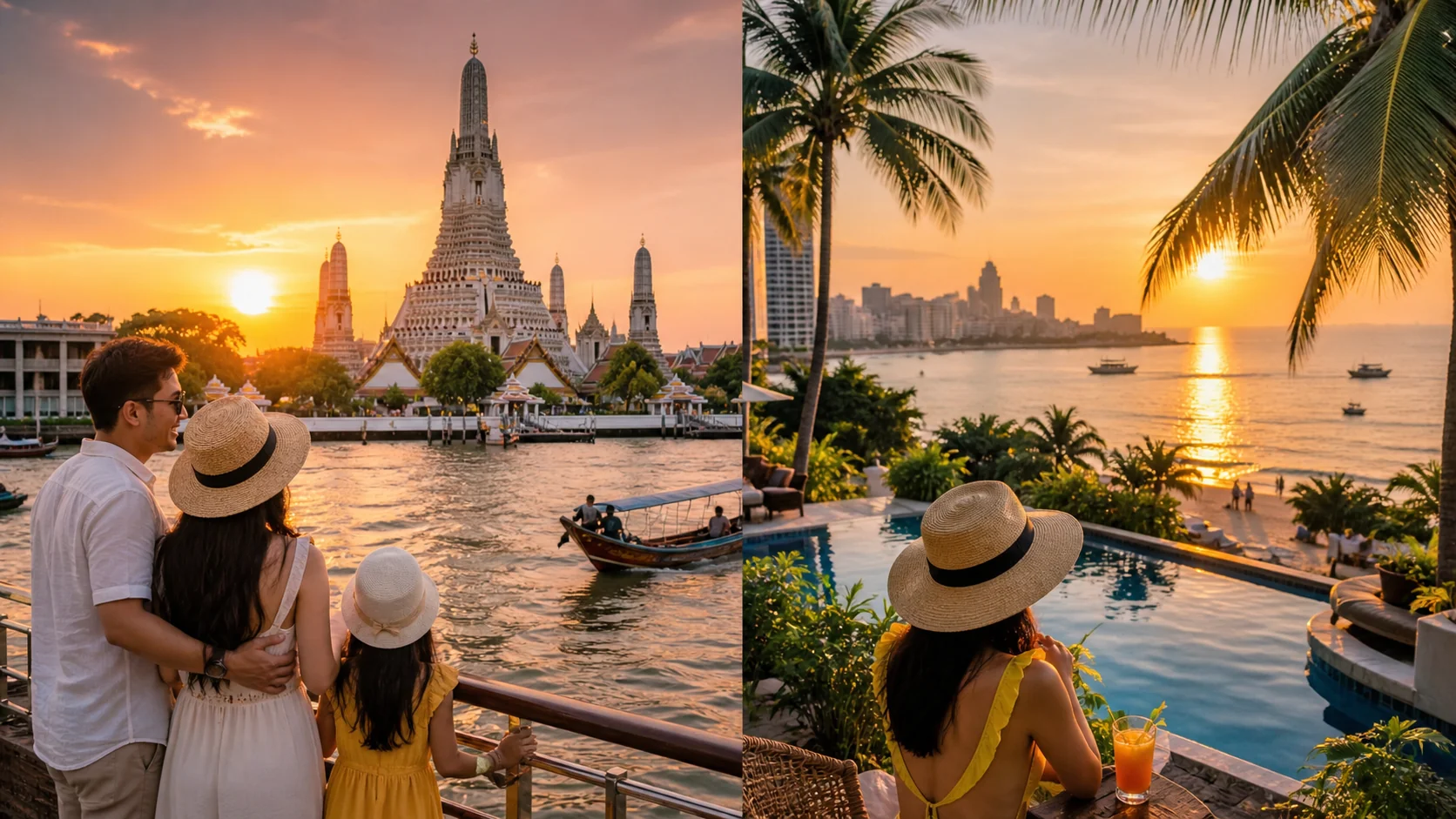
Choosing Thailand in January is not about glamour. It is about probability. Bangkok’s January climate normals read like a wish list for traveling with a toddler: average lows of 23.6 °C, highs of 32.8 °C, about 18 mm of rain spread over just four days in the whole month (1991–2020 observation normals). Pattaya is drier and slightly cooler still — daytime highs of 30–31 °C, 15–30 mm of monthly rainfall, and a sea temperature around 27 °C. While most of the northern hemisphere is shuttling children between indoor playgrounds through freezing air and dust warnings, a six-hour flight away there is a beach at 30 °C with humidity around 66% and a forecast that almost never mentions rain.
January 2027 adds a second, rarer condition. Chinese New Year (Chun Jie) falls on February 5–13, 2027 — a nine-day holiday — and South Korea’s Lunar New Year break lands on February 6–9. That makes January the last window before three East Asian travel migrations begin at once. Travelers who fly in mid-January meet airfares at roughly 60–70% of peak-season prices and hotel inventories before Chinese group bookings absorb the rooms. The worst stretches of this trip, by contrast, are January 1–3 and the first week of February.
This guide prices the same five-night, six-day itinerary (two nights in Pattaya, three in Bangkok) for a family of three with a three-year-old, twice: once as an all-LCC plus value-family-hotel plan at roughly 2.42 million KRW, and once as a full-service-carrier (FSC) plus five-star resort package at 4.2 million KRW or more. Along the way it covers where to book, how to pack for a 15 kg baggage limit, what a stroller can and cannot do in Bangkok, and how to move a toddler between airport, beach city, and capital without losing a day.
What this guide covers
- Why departing after January 1 saves a family of three 250,000–350,000 KRW, and when LCC fares for January actually bottom out
- The three LCCs flying Busan–Bangkok with real flight numbers, times, and the arrival slot that decides whether night one is rest or survival
- How Pattaya’s three districts differ for families, and a full profile of the value family resort that anchors the budget plan
- Why a skybridge-connected BTS hotel is close to non-negotiable in Bangkok with a stroller
- A private van price table for every leg, with child seat requests explained
- A line-item budget comparison table (LCC plan vs. five-star package) and four practical FAQs
1. LCC Fares in Peak January: Booking Strategy and the Baggage Reality
1-1. Skip the January 1 peak: 250,000–350,000 KRW for a family of three
January airfares respond less to the date itself than to the day of the week and the edge of the New Year holiday. January 1 is a day when the whole world moves at once: Korean travelers are flying home from the holiday, Bangkok outbound demand spikes, and European and Middle Eastern transfer traffic stacks onto the same hubs. As a result, departures on January 1 routinely price 80,000–120,000 KRW per person higher than the same route on January 3. For a family of three, that is 250,000–350,000 KRW — more than the cost of an extra night at the Pattaya resort (about 90,000 KRW). The rule is simple: depart on January 2 or later, almost always.
The second rule concerns weekdays. Within January, Saturday departures are the most expensive and Tuesday–Wednesday departures the cheapest. With a three-year-old, the sweet spot is a Tuesday-out, Sunday-home five-night trip that avoids cramming the whole holiday into a weekend. The third rule is timing: Southeast Asian routes release their cheapest inventory 8–10 weeks before departure. For mid-January travel, that means mid-November — right now — is effectively the last low-price window; after mid-December, remaining seats often jump by 100,000 KRW per person or more.
1-2. Busan (Gimhae) departures: three LCCs, evening departures, no red-eyes
From Busan, nonstop Bangkok service is effectively the territory of three Korean LCCs: Air Busan (BX), Jin Air (LJ), and Jeju Air (7C). All three leave Gimhae International Airport between 6 and 8 p.m. and land at Bangkok Suvarnabhumi (BKK) between 9:45 and 11:50 p.m. Flight time is 5h50m–6h10m; Korea is two hours ahead of Thailand.
| Airline | Flight (BKK-bound) | Departs PUS | Arrives BKK (local) | Return flight | Arrives PUS |
|---|---|---|---|---|---|
| Air Busan | BX725 | 18:00 | 21:45 | BX726 22:55 | 06:20 next day |
| Jin Air | LJ021 | 18:55 | 22:40 | LJ022 23:40 | 07:05 next day |
| Jeju Air | 7C2551 | 20:00 | 23:50 | 7C2552 00:50 | 08:30 next day |
Winter 2026 schedule. Frequencies and times shift by season and day of week; always confirm on the booking screen.
Here is the detail families with a three-year-old must weigh. The Suvarnabhumi Airport Rail Link stops running at midnight. Jeju Air’s 7C2551 lands at 23:50; by the time immigration and baggage claim are done, midnight has passed, and the van ride to Pattaya still takes 90 minutes to two hours. Resort check-in lands after 1:30 a.m. — with a woken toddler in the back seat. Air Busan’s BX725, landing at 21:45, puts the family at their Pattaya resort around 11:30 p.m. on the same itinerary. When the fare difference across three passengers is within 50,000–100,000 KRW, the 21:45 arrival changes the quality of the entire trip.
Busan departures have a second structural advantage: every flight uses Suvarnabhumi (BKK). Some Incheon LCC rotations land at Don Mueang (DMK), adding an inter-airport transfer when the hotel is in central Bangkok or Pattaya. When scanning Incheon options, filter out any arrival between 2 and 4 a.m. — red-eyes that two adults can survive but a three-year-old pays for with the entire next day. Daytime arrivals into Incheon routings (3–6 p.m.) exist, but they cost a 4–5 hour Surface transfer from Busan first. For a Busan-based family, Gimhae’s evening departures plus a late first-night check-in win on total door-to-door time.
1-3. Airline websites vs. OTAs: the three points where they diverge
Identical seats can carry different total costs and very different flexibility depending on where you pay. Three points decide it in practice:
- Checked baggage inclusion. LCC base fares usually include cabin baggage only (10 kg), with 15 kg checked sold separately. Some carriers, Jin Air among them, bundle 15 kg into certain fare tiers. The only honest comparison is displayed fare + 15 kg × 3 passengers. A one-way 15 kg add-on typically runs 20,000–30,000 KRW, 20 kg around 30,000–40,000 KRW.
- Name-change rules. OTA bookings typically charge a reissue fee plus any fare difference for correcting a misspelled name, while airline direct channels often block name changes entirely and force a cancellation plus rebooking. Check the passport’s English spelling — surname order, spacing, middle names — before paying, not after.
- Cancellation fees and refunds. OTAs stack their own fees on top; airlines follow their published fare rules, and promotional fares are usually non-refundable. Because a toddler’s trip is more likely to wobble than two adults’ — fevers happen the night before departure — paying 30,000–50,000 KRW more across three passengers for a changeable fare is often the rational buy.
In short: OTAs tend to win on price, airline direct channels win on change and cancellation support. Before paying anywhere, confirm the baggage and cancellation terms on the same screen, and compare the final amount including the 1–2% foreign transaction fee on your card and the FX spread if paying in KRW.
1-4. Flying with a three-year-old: seats, strollers, and cabin tactics
First, the most common misconception. A three-year-old is not an “infant” — she is a “child.” Infants (under 2) sit on a caregiver’s lap; a three-year-old occupies her own seat at child fare. A family of three books two adults + one child, three seats. Child fares run roughly 75–90% of the adult fare, so budgeting on the “infant pays 10%” assumption breaks the estimate.
Strollers travel two ways. Cabin carry-on works only for ultra-compact folding models (BabyZen YOYO, Joolza class) that fit an overhead bin, and acceptance varies by airline and aircraft. Most families use gate check (“door-to-door”): fold the stroller at the jet bridge, hand it over, and receive it on the tarmac at arrival — the airport transfer chain never breaks. Gate-checked strollers fly free; damage compensation follows each airline’s rules, so get a stroller tag at the counter and photograph the folded stroller before boarding.
In the cabin, cabin pressure is the event to manage. Fill a straw cup before takeoff and start offering small sips about ten minutes before departure — the swallowing helps equalize ear pressure. Gimhae’s international terminal has nursing rooms and a small play area, and the departure-level seating is generous. Book and assign all three seats together at reservation time: LCC seat selection costs 3,000–7,000 KRW per person per leg, which is cheap insurance against the scenario where the toddler’s seat ends up rows away from a parent on a six-hour flight.
2. Pattaya Hotels: A Value Family Resort, Analyzed
2-1. Pattaya divides into three zones
- North Pattaya / Naklua: the quietest corner. Local markets, calm stretches of sand, a mix of large condos and resorts. Great for stroller walks, but 10–15 minutes by car from the action.
- Central (Beach Road / Second Road): Terminal 21 Pattaya, Central Marina, Big C, and the night markets within walking distance. Maximum convenience, but evenings mix bar and club noise. With a toddler, pick a hotel on the strips’ quieter side with rooms facing away from the road.
- Jomtien: the southern beach, lined with resort-style properties, quieter overall. But 15–20 minutes by car from central Pattaya, and one more leg added to every Bangkok transfer.
For a two-night stay with a three-year-old, north-central Pattaya around Second Road is the answer: water play, shopping malls, and the beach all within stroller distance, and no time burned on transfers.
2-2. Mercure Pattaya Ocean Resort: the value sweet spot at 80,000–100,000 KRW a night
The property that best fits these conditions is the Mercure Pattaya Ocean Resort. The address is 463/100 Moo 9, Pattaya Second Road (North Pattaya), and the hotel’s own materials put Pattaya Beach at a 3-minute, 200-meter walk; guest reviews place it between 200 and 500 meters depending on the exit used — stroller distance either way.
- Location: Terminal 21 Pattaya in 5–7 minutes on foot, with Central Marina and Big C also walkable. Having an indoor, air-conditioned playground-and-mall complex a stroller away is what makes a rainy afternoon with a toddler survivable.
- Water play: a ground-floor mini water park (slides, a climbing wall, cave-style structures) plus a family pool, and a separate fifth-floor infinity pool for adults. Kids play below; parents recover above with a skyline-and-sea view.
- Rooms: Superior through Executive Family Suites, a kids’ club, and scheduled kids’ activities.
- Price: in January peak season it commonly books at 80,000–100,000 KRW a night (about 2,000–2,500 THB). Two sister properties share the block — ibis Pattaya (budget) and Holiday Inn Pattaya (closest to the beach) — all owned by the Erawan Group, so the real choice among the three is which you prioritize: budget, toddler water play, or beach proximity.
Check before booking: as of November 2026, Accor’s official pages list the mini water park, kids’ activities, and family suites, but the previously advertised splash pool and slide pool labels have disappeared. Renovations can move facilities around, so email the hotel and confirm the slide and kids’ pool are operating before you book around them. If a full water park is the point of the stay, Ramayana Water Park or Cartoon Network Aquaverse deserve their own day-trip line in the itinerary instead.
3. Bangkok Hotels: Why the BTS Skybridge Is Everything
3-1. Strollers and Bangkok roads do not mix
The real adversary in Bangkok is not the heat — it is the sidewalks and the traffic. Major arterials have broken or missing pavements, few marked crossings, and plenty of stairway footbridges. A ten-minute car distance becomes forty in the 5–8 p.m. jam, and a crying toddler in gridlocked traffic is the standard failure mode of a Bangkok family trip.
The fix is one decision: stay at a hotel directly connected by skybridge to an elevated BTS station. Step out of the elevator on level 2 or 3, ride the escalator, and you are on the platform — no street crossing, no rain, no folding the stroller at a stairway. BTS trains run on time regardless of surface traffic, and most stations have elevators. In Bangkok the standard is not “near a station” but “connected to a station.”
3-2. Eastin Grand Hotel Sathorn: a level-3 skybridge and a 14th-floor infinity pool
The property that satisfies this most precisely is the Eastin Grand Hotel Sathorn.
- Location and transit: 33/1 South Sathorn Road, a 33-floor, 390-room tower. Its third-floor enclosed skybridge connects directly to Surasak BTS station (Silom line, S5) — you reach the platform without stepping outside. Saphan Taksin, the transfer point for Chao Phraya river boats and the free shuttle boats to ICONSIAM and Asiatique, is two stops away.
- Pool: the 14th floor holds an outdoor infinity pool plus a separate children’s pool, open 06:00–22:00, with the Mahanakhon tower in the skyline view. Early morning and the golden hour are the quiet windows; the 24-hour fitness center shares the floor (keycard access).
- Rooms: all 390 rooms are a generous 32 m², and a Superior Sky Triple category means a family of three sleeps on real beds without a rollaway. Children under 16 stay free sharing parents’ bedding.
- Price: from about 3,200 THB (≈130,000 KRW) a night. Rooms with 32nd-floor Executive Lounge access bundle breakfast, afternoon tea, and evening cocktails — which in practice becomes the parents’ shift-rest system while the toddler naps.
3-3. Sukhumvit vs. Riverside: what you gain, what you give up
Sukhumvit (Asok–Phrom Phong) wins on density: shopping, restaurants, and the BTS interchange at Asok put Terminal 21 and Siam within ten minutes. The cost is the city’s worst surface congestion and hotel frontages that face the party streets — noise depends on floor and direction. The Riverside (Sathorn–Chao Phraya) trades some shopping convenience for wider rooms, river-and-temple sightseeing lines, and quieter evenings; riverside hotels also trend expensive.
For a five-night trip with a three-year-old, the Sathorn–Silom seam (Surasak) is the balance point: eight BTS minutes to Siam, two stops to the river piers, large rooms, and quiet nights. When the priorities are a toddler’s nap and parents’ dinners both being protected, it is the lowest-regret choice.
4. Airport–Pattaya–Bangkok: the Family Transfer Plan and Van Booking
With a three-year-old, two or three suitcases, and a stroller, joining the taxi queue at arrivals is the wrong move. Book a private van with a name-board meeting service in advance — fixed, toll-inclusive pricing and no meter negotiation, with the driver waiting when you clear customs.
| Leg | Duration | Sedan (3 pax) | SUV | Van (7 pax) | VIP Van |
|---|---|---|---|---|---|
| Suvarnabhumi → Pattaya | ~1.5–2 h | 1,200–1,500 THB | 1,500–1,600 THB | 1,800–2,000 THB | 2,500–2,900 THB |
| Pattaya → central Bangkok | ~2–2.5 h | 1,900 THB | 2,000 THB | 2,300 THB | 3,200 THB |
| Central Bangkok → Suvarnabhumi | ~45–60 min | 600 THB | 800 THB | 1,100 THB | — |
Per vehicle, one way, tolls included, verified September–November 2026. Rates vary by operator, season, and luggage volume. Converted at 1 THB ≈ 40 KRW (November 11, 2026).
- Child seats: available on request — free at some operators, 300 THB at others. When booking, state the child’s age (under 4) and weight together with the request. Thailand has required child restraints for children under six since August 17, 2023 (fines up to 2,000 THB), but public vehicles including taxis and public vans are exempt. The law’s exemption does not make a lap child safe at highway speed — book on the condition that a seat is fitted.
- Waiting and delays: most operators hold 60 minutes of free waiting at the airport when you pass your flight number; late immigration does not reduce it.
- Meeting point: Suvarnabhumi gate numbers differ by operator (gate 3–4 in arrivals, or level-4 gate 4, and so on). Screenshot the confirmation message with driver name, phone, and plate so you are not wandering arrivals with a toddler.
- Cost: three van legs total roughly 5,000–5,200 THB (200,000–210,000 KRW). That is close to what three adults’ worth of app-hailed rides would cost leg by leg — the difference is that the child seat, the luggage space, and the confirmation are guaranteed.
For the Pattaya-to-Bangkok day, leave at 9–10 a.m. After noon, the approach into central Bangkok can stretch a 2.5-hour drive to 3.5. Arrive, drop bags at the hotel, and ride the BTS into the afternoon with the day intact. With a 22:55 return departure (BX726), target airport arrival by 7:30 p.m. — three hours before departure — leaving the hotel around 6:30 p.m.
5. Bangkok–Pattaya Family Budget: Line-Item Comparison (Family of 3, January 2027)
The same five-night itinerary, priced both ways. Exchange rate 1 THB ≈ 40 KRW; January peak-season rates.
| Item | LCC + value family plan (≈ 2.42M KRW) | FSC + 5-star resort package (≈ 4.2M+ KRW) |
|---|---|---|
| Flights (3, round trip) | ≈ 1,080,000 KRW ~360,000 per person incl. 15 kg checked, evening departure from Busan |
≈ 1,500,000 KRW ~500,000 per person incl. seat selection, meals, 23 kg |
| Pattaya hotel (2 nights) | ≈ 190,000 KRW Mercure Pattaya Ocean Resort, 90,000–100,000/night |
≈ 760,000 KRW 5-star resort, 380,000/night |
| Bangkok hotel (3 nights) | ≈ 450,000 KRW Eastin Grand Sathorn triple, ~150,000/night |
≈ 1,140,000 KRW 5-star riverside, 380,000/night |
| Private van transfers | ≈ 210,000 KRW Van × 3 legs (airport→Pattaya→Bangkok→airport), child seat |
≈ 250,000 KRW Resort pickups + 2 city transfers |
| Food and activities | ≈ 490,000 KRW 80,000–90,000/day for 3 + water park & entries |
≈ 550,000 KRW Resort breakfast included, restaurants focus |
| Total | ≈ 2,420,000 KRW | ≈ 4,200,000 KRW |
| Difference | ≈ 1,780,000 KRW — the five-star package costs 1.74× | |
1.78 million KRW is about 1.6 extra sets of round-trip flights for three people, or nineteen additional nights at the Pattaya resort’s low-season rate. Spent or saved? If a five-star package’s breakfast, lounge, and service are worth that to you, that is a legitimate answer. But paying 4-million-plus for a January five-star package versus seeing the same weather and the same sea for 2.42 million is the comparison this article exists to settle.
6. Bangkok–Pattaya Family FAQ
Q1. What is January weather like, and how should we dress a toddler?
Bangkok runs 23–33 °C in January; Pattaya 23–31 °C. Short sleeves for the day, a light long-sleeve layer for mornings, evenings, and indoors is the formula. The real hazard is not heat but air conditioning: BTS carriages, malls, hotel breakfast rooms, and private vans routinely sit at 22–24 °C, and a sweaty toddler walking into that draft is how colds start. Pack two light long-sleeve tops, one thin windbreaker, two pairs of socks, and a small towel in the diaper bag and most of the problem disappears. UV is near its annual peak — hat, sunscreen, and a stroller shade are essentials. January rain is a brief passing shower at most; one compact umbrella is plenty.
Q2. Do Grab or Bolt in Bangkok offer a car seat or take a stroller?
Straight answer: neither Grab nor Bolt offers a car seat option in Bangkok. Grab operates a car-seat category (GrabFamily) in Singapore only; in Thailand both apps dispatch ordinary cars, and metered taxis carry no seats either. Thailand’s under-six car seat rule (since August 2023, fines up to 2,000 THB) does not apply to public vehicles including taxis, so a seatless ride-hail car is not breaking the law — but a toddler on a lap on a highway is not acceptable either. Three workarounds: ① book a private van with a child seat request for airport and intercity legs (the realistic option); ② replace short city hops with the BTS, and use Grab only for short distances with “no seat” as the default; ③ bring a portable foldable booster from home. Strollers fit most Grab trunks; when luggage is heavy, selecting Grab SUV reduces failures.
Q3. How warm and how safe are the kids’ pools at Mercure Pattaya and Eastin Grand Sathorn?
Both are outdoor pools without heating. With Pattaya’s January sea at ~27 °C, hotel pools run 27–30 °C in the afternoon — comfortable for a three-year-old’s 20–30 minutes. Before 9 a.m. and after sunset the water feels cold, so aim for 10 a.m.–4 p.m. On safety: Mercure’s ground-floor family pool and mini water park are separate zones with a clear toddler area, and the lounge beside the water park lets a parent sit and watch. Eastin’s 14th-floor infinity pool plus separate kids’ pool are also zoned, but on a high floor the rule is absolute: a hand on the child at the pool edge, always. Both provide towels; neither stocks child-sized flotation, so pack a swim ring or armbands from home.
Q4. How does a family of three stay under a 15 kg LCC baggage limit?
The trick is distribution, not weight. Three passengers on a five-night trip control 45 kg checked (15 kg × 3) plus 30 kg cabin (10 kg × 3) — the failure mode is concentrating it all in one big case. In practice: ① split across two 20-inch checked cases + one 18-inch cabin case + the stroller; ② put the heavy items in cabin bags — check-in counters weigh strictly, cabin boarding loosely; ③ pack the toddler’s clothes one zip-lock bag per day so remaining weight is always predictable; ④ buy diapers, wipes, and snacks at a local 7-Eleven or Big C — carrying five days’ worth costs 3–4 kg for no reason; ⑤ reserve one checked allowance for duty-free on the return. Overage fees commonly exceed 10,000 KRW per kilo per leg — exceeding 15 kg by 1–2 kg is the most expensive way to buy nothing.
7. Closing — and What Comes Next
A January Bangkok–Pattaya family trip succeeds or fails on three decisions, not on the itinerary’s ambition. First, the departure date — a weekday after January 2. Second, an arrival before midnight. Third, a skybridge-connected BTS hotel in Bangkok. Get those three right and a five-night trip with a three-year-old ends with parents still standing. Get one wrong, and the rest of the budget and the schedule are spent absorbing it.
All figures here use the November 11, 2026 exchange rate (1 THB ≈ 40 KRW) and January peak-season pricing. Airfares move with booking time and hotels with cancellation windows — confirm the final amounts on the booking screen before committing.
Next, the series widens. Day 8 — 2027 World Travel Calendar, Part 1: Asia. A month-by-month table of the best months to visit Japan, Taiwan, Vietnam, Thailand, and Bali, with dry/wet season calendars, festivals, and the peak windows to avoid — and where Thailand’s January sits among Asia’s twelve months.
Sources
Climate normals: Bangkok 1991–2020 observation normals (January lows 23.6 °C, highs 32.8 °C, 18 mm rain over 4 days); Pattaya January highs 30–31 °C, rainfall 15–30 mm, sea temperature ~27 °C; WeatherSpark Bangkok climate analysis (beach/pool score peaks in the second week of January)
Flight schedules: Air Busan BX725/BX726, Jin Air LJ021/LJ022, Jeju Air 7C2551/7C2552 — winter 2026 season, Gimhae–Suvarnabhumi; subject to seasonal change
Hotel information: Accor official pages for Mercure Pattaya Ocean Resort (verified November 2026); Eastin Grand Hotel Sathorn official facilities pages (14F pool 06:00–22:00, level-3 skybridge to BTS Surasak)
Transfer rates: Suvarnabhumi–Pattaya private vehicle price tables (verified September–November 2026), per vehicle, tolls included
Child restraint law: Thailand Land Traffic Act Section 123, as amended 2022, effective August 17, 2023 — under-6 child seats, under-135 cm seatbelt rule, fines up to 2,000 THB, public vehicle exemption
Exchange rate: 1 THB ≈ 40 KRW (November 11, 2026)
Note: airfare, hotel, and transfer prices swing widely in peak season — always judge by the amounts shown at your actual time of booking.