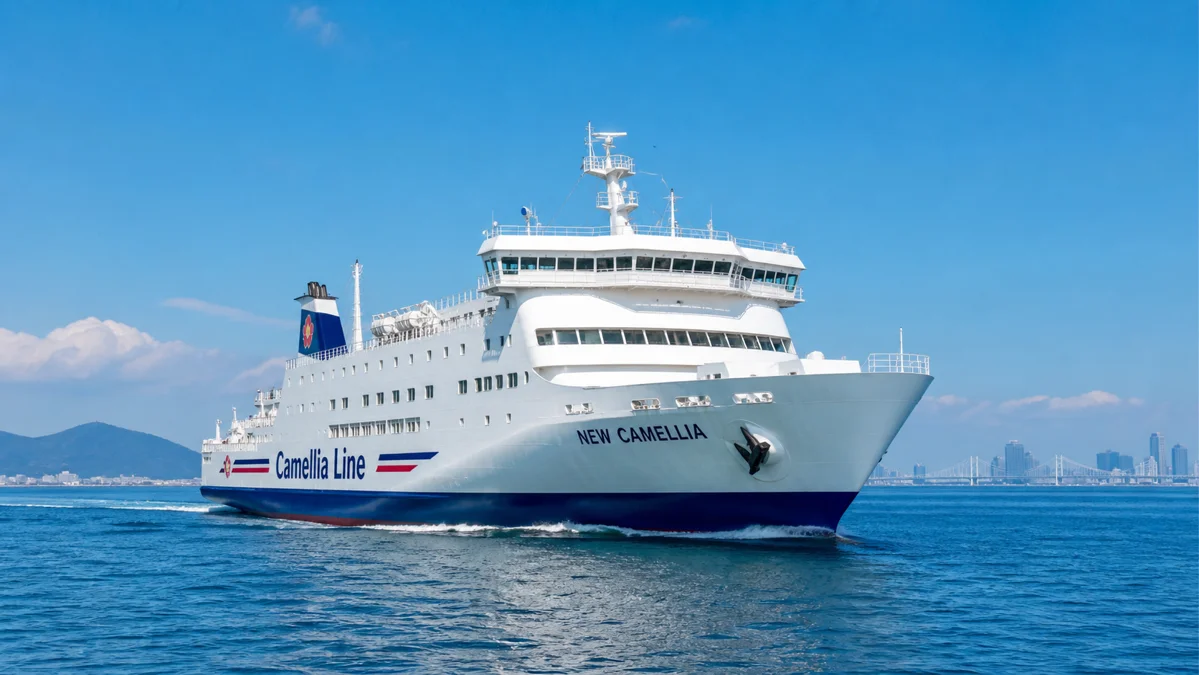
In one line: As of November 2026, the New Camellia is the only scheduled passenger ship between Busan and Fukuoka. Add the wharfage, departure levy, fuel surcharge and Japan’s international tourist tax and a round trip for one adult comes to roughly KRW 344,000–374,000. A low-cost round trip from Busan runs about KRW 224,000 on a weekday and KRW 313,000 at a weekend. On transport cost alone, the plane wins. But the ferry puts a night of accommodation inside the ticket and lets you walk aboard with up to 30 kg of luggage for free. This is the arithmetic, carried all the way to the last won.
Fukuoka has always felt strangely close to Busan: an hour by air, a night by sea. For years the line “the ferry is cheaper” held. Then two things changed. On 1 October 2026 the New Camellia revised its passenger fares and abolished round-trip and student discounts. And in July 2026 Japan tripled its departure tax, from JPY 1,000 to JPY 3,000. Anyone booking from memory will find the numbers no longer agree.
These are the ground rules for this article. Everything was checked on 15 November 2026, at an exchange rate of JPY 100 = KRW 836. Passenger fares are the 1 October 2026 revision; fuel surcharges and taxes are for tickets issued October–December 2026. Air fares are real round-trip totals, taxes and fuel surcharges included, read off travel-agency screens on the same day, with dates given. Prices move, so confirm with the shipping line and the airline before you book.
1. Only one ship is left on the Busan–Fukuoka sea route
Start by clearing out the outdated reviews. The Queen Beetle, the hydrofoil that crossed in 3 hours 40 minutes, is gone. It stopped operating on 13 August 2024 after the concealment of hull flooding came to light, and on 23 December 2024 JR Kyushu decided to withdraw from the high-speed vessel business altogether. The ship was sold to Korea’s PanStar Line.com in April 2025, with a condition that it would not be deployed on Korea–Japan routes, including the Korea Strait. In 2026 the New Camellia is the only scheduled passenger ship between Busan and Hakata, and the Hakata Port International Terminal’s own information lists no other vessel for the Busan route.
How the New Camellia runs
- Busan → Hakata: check-in 16:30–18:30, boarding closes 20:00, departure 22:30, disembarkation from 07:30 the next morning.
- Hakata → Busan: check-in 10:30–11:30, boarding closes 12:10, departure 12:30, arrival in Busan 18:30.
It looks like a daily service, but the ship takes roughly one day a week off. In November 2026 there is no scheduled sailing from Busan on the 7th and 28th, and none from Hakata on the 8th and 29th. Around the New Year, extra sailings leave Hakata at 18:00 and disembark in Busan at 08:30 the following morning. As with a flight, check the operator’s notice the day before you travel.
2. The real fare, item by item: what “wharfage and fuel tax” actually means
Search for the ferry and the first number you see is KRW 150,000 for second class. You cannot board for KRW 150,000. Taxes and surcharges are added on top. The operator calls the bundle TAX; passengers usually call it wharfage and fuel tax.
Leaving Busan: KRW 21,000 per adult
- Fuel surcharge KRW 14,000 (free under age 2, adjusted monthly).
- Wharfage, formally the international passenger terminal fee: KRW 6,000 (free under age 6).
- Departure levy: KRW 1,000 (free under age 12, funded through the tourism development fund).
The departure levy surprises people. By air it is KRW 7,000; by sea it is KRW 1,000. The tourism development fund regulation simply sets a different amount for vessels. Air passengers also pay a KRW 12,000 international airport facility fee at Gimhae, so the departure-related charges inside an air ticket total KRW 19,000.
Returning from Hakata: JPY 4,900 per adult
- Fuel surcharge JPY 1,400.
- Japan’s international tourist tax JPY 3,000 (free under age 2).
- Hakata terminal fee JPY 500 (free under age 6; JPY 250 for ages 6–11).
This is why the return leg costs more. Japan’s international tourist tax rose from JPY 1,000 to JPY 3,000 for departures on or after 1 July 2026. Tickets issued on or before 30 June 2026 keep the old JPY 1,000 rate under a transitional measure, but any ticket bought now carries JPY 3,000. The same JPY 3,000 sits inside an airline ticket when you fly home. It is less that ferries are heavily taxed than that every departure from Japan now carries a JPY 3,000 stamp.
The operator also publishes the TAX in won. For tickets issued October–December 2026, the Hakata-side TAX for an adult is fixed at KRW 45,710 (child KRW 43,380, infant KRW 41,050). Because the line applies its own conversion rate, this is slightly more expensive than paying in yen directly — a gap we come back to in the booking strategy.
One more detail: TAX follows the issue date, not the sailing date. Buy today and a later fuel-surcharge increase will not be charged to you, nor will a decrease be refunded. Buy a late-December ticket in January and January’s TAX applies. For a year-end trip, issuing the ticket in December keeps the arithmetic simple.
3. Total round-trip cost for one adult, taken to the end
Now the money that actually leaves your account. One adult, round trip, second class on the ferry against economy on a low-cost carrier, with city access from Busan Station on both sides: bus to the Busan Port International Passenger Terminal, subway to Gimhae Airport.
| Item (one adult, round trip) | New Camellia (round trip booked on Korean site) |
New Camellia (cheapest split booking) |
Low-cost flight (weekday quote) |
Low-cost flight (weekend quote) |
|---|---|---|---|---|
| Fare (2nd class / economy) | KRW 300,000 (150,000 × 2) | KRW 300,000 | included | included |
| Busan-side TAX | KRW 21,000 (fuel 14,000 + wharfage 6,000 + levy 1,000) | KRW 21,000 | included (levy 7,000 + Gimhae facility fee 12,000) | included |
| Hakata-side TAX | KRW 45,710 (equivalent of JPY 4,900, operator’s won rate) | about KRW 41,000 (JPY 4,900 × 8.36) | included (Japan tourist tax JPY 3,000 inside) | included |
| City access (round trip) | KRW 7,400 (bus 1,550 × 2 + bus JPY 260 × 2) | KRW 7,400 | KRW 7,900 (subway 1,800 × 2 + subway JPY 260 × 2) | KRW 7,900 |
| Total | about KRW 374,100 | about KRW 344,800 | about KRW 224,000 | about KRW 313,400 |
| Door-to-door travel time | about 16 hours (12 at sea + 4 in procedures) | same | about 7 hours (2 flying + 5 at airports) | same |
Here is how those figures were built. Booking the whole round trip on the Korean site gives a fare of KRW 300,000 plus Busan TAX of KRW 21,000, Hakata TAX of KRW 45,710 and KRW 7,400 of city access: about KRW 374,000. But book the outbound on the Korean site in won and the return on Camellia Line’s Japanese site in yen, and the Hakata TAX is no longer KRW 45,710 but JPY 4,900, or about KRW 41,000. Same ship, same cabin, and splitting the booking saves roughly KRW 30,000, bringing the total to about KRW 344,800.
Air fares swing much more with the date. On 15 November 2026, a mid-December weekday round trip (out 14 December, back 16 December) showed a lowest fare of KRW 216,100, while the same week’s weekend (12–14 December) started at KRW 305,500. Agency quotes for 16–17 December put Jeju Air at KRW 220,494 and Air Busan at KRW 261,998–272,039. In peak season and at year-end, expect to pass KRW 300,000.
So: on an off-peak weekday the flight is more than KRW 100,000 cheaper than the ferry. At a weekend or year-end the gap narrows to about KRW 30,000. Add the hotel night the ferry replaces — KRW 80,000–120,000 for a business hotel near Hakata Station — and the ranking flips. At weekends, the ferry’s effective cost is lower than the flight’s.
4. Baggage: 30 kg free against 10 kg, where the ferry runs away with it
Do not give up on the ferry because of the fare table. Its real weapon is luggage. New Camellia’s carry-on rules are startlingly generous.
- Free carry-on into the cabin: up to 30 kg, with the three sides totalling no more than 200 cm. You wheel the case into your own cabin and that is the end of it.
- No liquid screening: bottles bought within the duty-free allowance can go straight into your bag. No 100 ml bag rule.
- Checked baggage (paid): JPY 800 / KRW 8,000 for up to 20 kg per piece, plus JPY 300 / KRW 3,000 per additional 10 kg. Acceptance is 16:30–17:30 in Busan and 10:30–11:30 in Hakata.
- Strollers: lent free at the counter; you may also fold and carry your own.
- Bicycles: JPY 1,500 / KRW 15,000 carried in the cabin (first six per sailing), or JPY 2,000 / KRW 20,000 checked. E-bikes are not accepted.
There are exclusions. Some sailings — including Hakata night departures — and the year-end period (Busan departure 28 December 2026 to Hakata departure 3 January 2027) do not accept checked baggage at all. Heavy bags are better carried yourself on those dates.
| Item | New Camellia | Air Busan | Jin Air | Jeju Air |
|---|---|---|---|---|
| Free cabin allowance | 30 kg, three sides up to 200 cm | 1 piece 10 kg (55×40×20 cm) + 1 small bag | 1 piece 10 kg + 1 personal item | carry-on + personal item, 10 kg combined |
| Free checked allowance | none (paid: 20 kg for KRW 8,000) | none on promo fares / 15 kg on saver and standard | 15 kg on Japan routes | none on BASIC / 15 kg on STANDARD |
| Liquids | no restriction | 100 ml in cabin, allowed in checked | 100 ml in cabin, allowed in checked | 100 ml in cabin, allowed in checked |
| Golf bags, bicycles | bicycles at a special rate; golf bag as normal baggage | golf bag counted in 15 kg, excess charged | bought as excess baggage | bought as excess baggage |
The number to watch is not “15 kg free checked”. It is that an airline lets you carry only 10 kg into the cabin, and that this 10 kg often includes the bag from the departure-hall duty-free shop. Jeju Air counts the carry-on, the personal item and duty-free purchases together against 10 kg. Two bottles of whisky weigh about 2 kg, so the moment your case passes 8 kg you are checking a bag at the gate. On the ferry that calculation does not exist.
5. Six hours is not wasted time — it is your hotel night
The main objection to the ferry is time. Six hours from Hakata to Busan on the day sailing; nine hours from Busan (5.5 at sea plus alongside) on the night sailing. Fifteen hours afloat on a round trip against two hours in the air looks like a bad trade.
What changes is where those hours sit. The 22:30 sailing from Busan puts sleep inside the journey. You eat dinner, board, sleep in a second-class berth or a private room, and step off in Hakata at 07:30. Hotel check-in, luggage storage and breakfast all disappear, and you have Fukuoka from eight in the morning. That is the value of the hotel night the ferry replaces.
The day sailing is used differently. Leaving Hakata at 12:30, you shop in Tenjin in the morning, finish ticketing by 11:30 and board. Six hours go on a bath with a sea view, lunch in the restaurant and the open deck. Arriving in Busan at 18:30 leaves the evening free. With a small child, those six hours are easier than one hour strapped into a seat — a point covered at length in the second article of this series (Fukuoka ferry vs flight with a toddler).
The flight’s time should be counted honestly too. Busan Station to Gimhae Airport is 53 minutes and KRW 1,800 by subway. Allow 90 minutes for check-in and security, an hour in the air, then the free shuttle (about 10 minutes) and two subway stops (5 minutes, JPY 260) to Hakata Station, 20 minutes in all. Door to door, about seven hours round trip. The trade is plain: the ferry spends 15 hours and removes a hotel night and every luggage worry; the flight spends 7 hours and you pay for the room separately.
6. Whisky and liquor shopping: allowances, refunds, and the Busan port trap
This is the most practical section of the article. November 2026 is a month in which two sets of rules changed at once.
Entering Korea: 2 litres and USD 400, with no bottle limit
Korea’s traveller allowance for alcohol is 2 litres or less in total volume and USD 400 or less in total value, both at once. A revision to the Enforcement Rule of the Customs Act on 21 March 2025 removed the old two-bottle cap, so bottles are no longer counted — volume and value are.
- Two 700 ml bottles of whisky = 1.4 L → within the limit, if the price is under USD 400.
- Three 700 ml bottles = 2.1 L → over the volume limit. It is the litres, not the bottles, that fail.
- Four 500 ml bottles = 2 L → within the limit.
- Whisky and sake together are added up: two 700 ml whiskies plus one 500 ml sake = 1.9 L.
The USD 400 liquor allowance is separate from the USD 800 general allowance. An expensive bottle does not eat into the USD 800, and the remainder of the USD 800 cannot extend it. Travellers under 19 have no liquor allowance at all.
Entering Japan, the rule is different again: Japan Customs allows three bottles of about 760 ml each per adult. Buy whisky at the Busan port or Gimhae departure-hall duty-free shop on the way out and this is the number that applies. The country you are entering sets the limit.
From 1 November 2026, Japan’s tax-free shopping became a refund
The second change concerns Japanese consumption tax. Until 31 October 2026 you paid the tax-excluded price in the shop. For purchases from 1 November 2026, you pay the tax-inclusive price and claim it back when you leave Japan. The procedure:
- Show your passport and pay the tax-inclusive price. The purchase must total at least JPY 5,000 before tax, per shop per day.
- At departure, complete the customs check before you check in your bags. Scan your passport at the tax-free kiosk; the screen shows green (no inspection) or red (inspection required).
- The consumption-tax equivalent is refunded after the check. The refund method depends on the shop and the refund operator.
One fact matters particularly at sea. Hakata Port International Terminal has a kiosk on the second floor, and Visit Japan Web is not available at seaports. The kiosk is the only route. You must have every item from the receipt with you, so finish the check before baggage acceptance (10:30–11:30). Checks are done per receipt: if one item from a receipt is missing, the whole receipt loses its refund. There is also no cash refund counter at Hakata Port.
The Busan port trap: the duty-free shop closes at 20:00
This one is unique to ferry passengers. The Busan Duty Free shop inside the third-floor departure hall of the Busan Port International Passenger Terminal operates 07:00–20:00. The New Camellia leaves Busan at 22:30. Even if you clear immigration early, the shop is shut. Online duty-free purchases can be collected at the third-floor counters of Lotte, Shinsegae and Shilla, but collection hours follow the sailing schedule, so confirm the pickup window before you pay. Gimhae Airport’s departure-hall shops, by contrast, are open around the flights. “I’ll buy the whisky at the departure hall because I’m going by sea” is a plan that can fail.
Where to buy
- Don Quijote Tenjin (1-20-17 Imaizumi): whisky on the third to fifth floors, with the mainstream Yamazaki, Hakushu and Hibiki lines; late or 24-hour opening. Use the tax-free counter with your passport.
- Bic Camera Tenjin, Building 1: the liquor corner is in Building C; coupons stack with the tax refund.
- Yamaya Daimyo: a serious liquor shop with broad sake and rare-whisky stock; good when buying several bottles at once.
- Iwataya department store, basement of the main building: home to a Dassai store. Tax refunds are handled at the seventh-floor counter in the new building.
- Fukuoka Airport duty-free: frequent reports that sake is cheaper here than in town — but that is a shop you only pass when flying out, so it is irrelevant to ferry travellers.
Be honest about prices. In 2025 at Don Quijote Tenjin, Yamazaki 12 was JPY 29,900, Hakushu non-vintage JPY 14,980 and Hibiki Japanese Harmony JPY 19,900. Japanese whisky is often dearer than in Korea now. The old idea that “whisky is cheap in Japan” no longer holds; the value today is in Scotch and sake. Real shelf prices include Johnnie Walker Blue at JPY 16,000 and Chivas Regal 12 Mizunara at JPY 3,880–4,280.
| Situation | Recommendation | Why, and what to check |
|---|---|---|
| Solo, weekday, one night, light bag | Low-cost flight | Round trip in the low KRW 200,000s; more than KRW 100,000 cheaper than the ferry. Book a hotel separately. |
| Two or more, weekend or year-end | New Camellia | Add the saved hotel night (KRW 80,000–120,000) and the effective cost reverses. |
| Travelling with a three-year-old | New Camellia | Leave bags in the cabin, no seat confinement for six hours, free stroller loan. |
| Several bottles of whisky or sake | New Camellia | No liquid restriction, 30 kg free in the cabin. Korea’s 2 L / USD 400 still applies on entry. |
| Same-day or one-night business trip | Low-cost flight | Seven hours door to door; the ferry’s 15 hours wreck the schedule. |
| You definitely want the tax refund | Either | At sea: the second-floor kiosk at Hakata Port, before baggage acceptance. No cash refund. |
7. Booking and boarding: a practical checklist
If you have decided on the ship, settle the booking channel first. Booking on Camellia Line’s Japanese site in yen is cheaper than paying in won even at list price, and bargain fares such as the “2nd class bargain” appear on some dates. On one trip I booked the Hakata–Busan second-class bargain at JPY 6,000 per adult, with surcharge and taxes on top. Bargain inventory is limited, so check early if your dates are fixed.
Cancellation terms differ by channel. On the Korean site, discount tickets can be cancelled free within 24 hours of payment; after that, KRW 10,000 up to four days before departure, KRW 20,000 from three days to one day before, and no refund on the sailing day. Bargain tickets are non-refundable after 24 hours. Counter tickets at the standard fare cost KRW 3,000 to cancel up to eight days before, 30 per cent of the fare from two days before, and 100 per cent on the day. If a child’s condition might change your plans, read that table first.
The day itself is simple. From Busan Station, bus 172 reaches the international passenger terminal in 18 minutes for KRW 1,550; a taxi is about the KRW 4,800 base fare for the 2 km. Check in between 16:30 and 18:30 and be aboard by 20:00. In Hakata, buses 88, BRT, 11, 19 and 50 reach Hakata Station in 17–18 minutes for JPY 260; BRT takes transport IC cards and contactless credit cards. Ticketing and baggage acceptance close at 11:30, so be on a bus from Hakata Station by 10:30.
8. Frequently asked questions
Q1. If the flight is cheaper, why take the ferry?
On transport cost alone, on a weekday, the flight wins. The ferry is chosen for a night’s accommodation and luggage. The 22:30 sailing puts sleep inside the journey, removing one hotel night in Hakata, and lets you bring 30 kg into the cabin for free. At weekends and year-end, when air fares climb, those two things reverse the price gap.
Q2. How many bottles of whisky can I buy?
Entering Korea, the limit is 2 litres and USD 400, with no bottle cap. Two 700 ml bottles (1.4 L) is the usual safe choice; four 500 ml bottles (2 L) also works. Three 700 ml bottles is 2.1 L and fails. Entering Japan, the allowance is three bottles of about 760 ml per adult.
Q3. Is 30 kg of luggage really free?
Yes, for baggage you carry into the cabin yourself: up to 30 kg with the three sides totalling 200 cm. If you would rather check it, it is KRW 8,000 / JPY 800 for up to 20 kg, plus KRW 3,000 / JPY 300 per extra 10 kg. Some sailings and the year-end period do not accept checked baggage at all.
Q4. What happens if the ferry is cancelled?
Sailings can be cancelled in bad weather. When cancellation is expected the operator posts a notice and sends a message, so check the day before and again on the morning of departure. Refunds and date changes follow the booking channel’s rules, with TAX settled separately from the fare. In winter swell, seasickness tablets work best taken 30–60 minutes before boarding.
Next in the series
Tomorrow, 16 November, is day twelve: the 2027 Americas and Oceania travel calendar. The US national parks in May and June, the Canadian Rockies and Niagara in June to September, the maple route in September and October, and Australia and New Zealand with their seasons turned upside down — a month-by-month table built from our own research. It is the final part of the three-part world travel calendar, after Asia and Europe.
All fares and rules here were checked on 15 November 2026. Fares, fuel surcharges and taxes change with the issue date and the exchange rate, and schedules and baggage rules change too. Before booking, confirm with Korea Ferry (koreaferry.kr) and Camellia Line (camellia-line.co.jp).