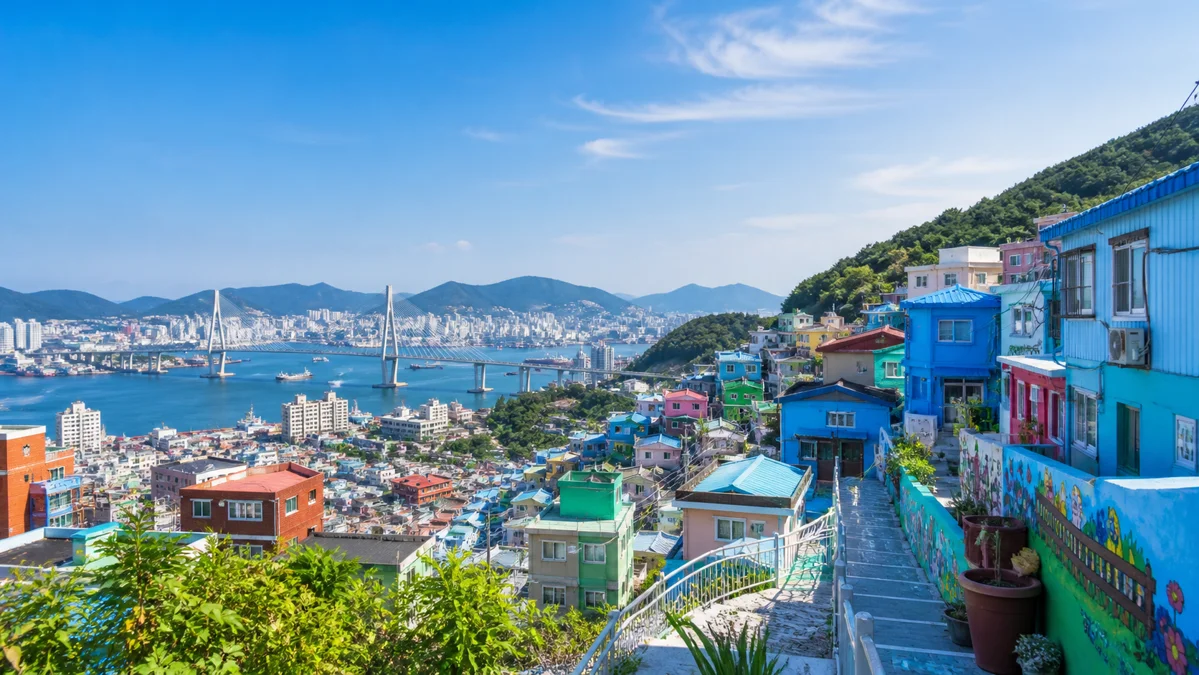
There is a walking route in Busan that takes you from the platform of Busan Station to the hillside road above the harbour without a single subway ride or village bus transfer. It is Choryang Ibagu-gil. Five minutes from Exit 7 of Busan Station you are standing in front of a hundred-year-old brick hospital; forty-five minutes later you are at the top of the 168 Stairs with the whole North Port spread out below you. Round trip 2.3 km, half a day if you actually stop and look.
One change matters more than anything else on this route in November 2026: the monorail beside the 168 Stairs is gone. The eight-seat monorail that ran from 2016 was declared unsafe, removed in January 2024, and replaced on 11 March 2025 by a 12-seat inclined elevator called Choryang 168 Stairs Haneul-gil (“the sky path”), which is free to ride. Travelers still arrive with printouts of old blog posts and find nothing but stairs. So this guide was rebuilt from what was actually confirmed on the ground on 14 November 2026, with measured walking times for every leg. Segment times and distances come from Kakao Map walking routes; the time spent waiting at the stairs and taking photographs is calculated separately.
Three-minute check before you leave: the three ways this walk fails
There is no admission fee and no reservation. The route fails for exactly three reasons. First, you go on a Monday. The alley, the stairs and the observation decks are open 365 days a year, but every indoor facility along the way closes on Mondays and public holidays. Second, you expect the monorail. It is an elevator now. Third, your shoes. Heels or slides will roll your ankle on a 33-degree staircase and a street that is never flat. Sneakers are, in practice, the ticket.
Season matters too. The Sanbok-doro alleys have almost no tree cover, so on a summer afternoon the handrail of the staircase is hot to the touch. On a rainy day water runs down the stairs in a thin sheet and the painted tiles get slippery — that is the day to skip the climb and use the elevator in both directions. The best hour of all is the forty minutes before sunset, when the container terminal lights come on one by one and the Busan Harbour Bridge switches on, all of it visible from the top of the stairs.
No monorail: since March 2025 it is the “Haneul-gil” inclined elevator
The 168 Stairs were the only direct link between the upper and lower halves of Choryang. Narrow and steep, they were a daily route for residents carrying water jars; today each step carries a small painted house and ceramic tile. There are 168 of them, the height of a six-storey building. The district office describes the gradient as 33 degrees over roughly 52 metres of travel.
The monorail installed in 2016 became a Choryang landmark, but it broke down constantly. An elementary school student was trapped in it for 40 minutes in 2018, three residents for 20 minutes in 2019, and in 2023 the Korea Transportation Safety Authority ruled it unfit to operate. It was removed, and on 11 March 2025 the inclined elevator took its place. Because the new car runs on a wire rather than a rack, noise and sway are much reduced, and capacity rose from eight to twelve — enough that a family of four no longer has to ride in two batches.
How to use the three stops
The elevator has three stops, and they are three different places. Ride to the top and straight back down and you miss half the route.
The lower stop is the 168 Stairs cultural exhibition space at the foot of the staircase. Board here and you reach the middle without climbing a single step. The middle stop is the Kim Min-bu Observatory, roughly eight-tenths of the way up, where the North Port, the harbour bridge and the rooftops of the old downtown fit into one frame. The wall carries the poem “A Waiting Heart” by Choryang-born poet Kim Min-bu. The upper stop lands at the Myeongnan Brand Institute, the Ibagu Platform startup cluster and the 168 The Deck, directly on Mangyang-ro.
So the combination that actually works: climb the stairs on the way up so you see the painted steps and the alley with your own eyes, rest once at the Kim Min-bu Observatory, and take the elevator down. If your knees are bad, or you are carrying a child, do the opposite — ride up, look down the staircase from the top, and skip the descent entirely. Walking down is harder on the knees than walking up, so if you want to avoid one direction, avoid the descent.
Nobody publishes the closing time
Neither the Dong-gu district office tourist information nor the Busan Tourism Organization lists an operating end time for the elevator. The only surviving record is from the monorail era: 7 a.m. to 9 p.m. from June to September, and to 8 p.m. in other months. The district says the elevator is quiet enough to run at night, but has not said when it stops. If you plan to be up there after dark, call the district’s Future Projects Division at 051-440-4781 or the main line at 051-440-4000, and assume you may have to walk down. The stairs never close.
The measured route in seven legs, from Busan Station to Mangyang-ro
The table below breaks the walk from Exit 7 of Busan Station to Yu Chi-hwan’s Mailbox into seven legs. Difficulty is rated on stairs and gradient; the transport note lists only what you can actually catch on that leg.
| Leg | Distance | Walk time | Difficulty | Field notes |
|---|---|---|---|---|
| 1. Busan Station Exit 7 → Old Baekje Hospital | 0.3 km | 5 min | Low (flat) | About 2 min inside the station to Exit 7, then 2–3 min to the alley. Leave luggage in the station lockers. |
| 2. Baekje Hospital → Namseon Warehouse site | 0.1 km | 2 min | Low | 88 m down the side alley. Only the red brick wall remains, easy to walk past. |
| 3. Namseon Warehouse → Wall Gallery & Portrait Wall | 0.3 km | 7 min | Low–moderate | Two crossings along Choryangjung-ro. The Choryang Elementary wall is the portrait gallery. |
| 4. Wall Gallery → foot of the 168 Stairs | 0.3 km | 7 min | Moderate (climb starts) | Turn off Choryangsang-ro into Choryangsang-ro 51beon-gil. Almost no shade from here. |
| 5. 168 Stairs & Kim Min-bu Observatory → Ibagu Craft Workshop | 0.2 km | 7 min | High (stairs) | 168 steps or the elevator. One more short flight at the top toward 168 The Deck. |
| 6. Ibagu Craft Workshop → Yu Chi-hwan’s Mailbox | 1.1 km | 17 min | Moderate (roadside) | Follows Mangyang-ro. The sidewalk disappears in places; keep checking for cars. |
| 7. Yu Chi-hwan’s Mailbox → Busan Station (descent) | 2.1 km | 23 min | Low (by bus) | 4 min walk to Choryang 6-dong Community Centre stop, 6 min on bus 508, 4 min walk at Busan Station. |
Legs 1–2: from the platform to two century-old buildings
Cross the main road from Exit 7 and the alley begins immediately. The first building is the old Baekje Hospital, a red brick structure from the 1920s and Busan’s first modern private general hospital, now a nationally registered cultural heritage site. It has served as a Japanese army officers’ quarters, a security headquarters, a temporary embassy of the Republic of China and a wedding hall; today the ground floor is a cafe and the upper floor a cultural space. In 2017 The New York Times included it among 52 places to go. Floors one and two are open, so you can step in and sit for a moment, but there is no parking.
Eighty-eight metres down the side alley is the Namseon Warehouse site. Built in the 1900s to store goods shipped down from Hamgyeong province, it was Busan’s first logistics warehouse and was nicknamed the “pollack storehouse” for the fish stacked inside. Only the red brick wall remains, a little taller than a person — best photographed when the afternoon sun rakes across it.
Legs 3–4: the Wall Gallery, then the climb begins
The Wall Gallery is an open-air gallery spread along the walls of the alleys around Choryangjung-ro 41beon-gil. Photographs and paintings record how Choryang’s streetscape and the lives of its people changed over the decades; the stretch along Choryang Elementary School’s wall introduces the district’s notable figures. There is no gate and no ticket office — it simply continues as you walk.
The first real test comes where Choryangsang-ro turns into Choryangsang-ro 51beon-gil. The alley narrows, the gradient bends upward, and from here to the foot of the stairs there is almost no shade. Buy water before this point; the convenience stores in the alleys are small and thinly stocked.
Leg 5: the 168 Stairs and the Kim Min-bu Observatory
At the bottom of the staircase, the cultural exhibition space and the lower elevator stop sit side by side. If you are climbing, count the 168 steps. Halfway up is the Kim Min-bu Observatory, and one rest there makes the rest of the climb feel short. The view from it — container cranes, the harbour bridge, the ridge of Yeongdo — is one of the two best photographic spots on the whole route.
At the top you reach 168 The Deck, the Myeongnan Brand Institute and the Ibagu Platform. Opened in March 2025, the Ibagu Platform is a youth start-up cluster with restaurants, a book cafe and a plant-interior cafe — a sensible place for a coffee once your breathing settles. The Myeongnan Brand Institute, built around Busan’s famous salted pollack roe, is open Tuesday to Sunday from 10 a.m. to 7 p.m. and closed Mondays and public holidays.
Leg 6: the longest 1.1 km of the day
The Ibagu Craft Workshop collects photographs and household objects from Sanbok-doro residents. The ground floor has a vintage school-uniform experience corner, and the roof deck looks straight out over the North Port. It is open Tuesday to Saturday 10 a.m. to 7 p.m. and Sunday 9 a.m. to 6 p.m., closed Mondays and public holidays. Next door at 488 Mangyang-ro, the third floor houses the Mangyang-ro Sanbok-doro Exhibition Hall, where the refugee years and the neighbourhood’s regeneration are told through film and hands-on displays.
From here to Yu Chi-hwan’s Mailbox is 1.1 km, seventeen minutes on foot. The distance is not the problem; the road is. Mangyang-ro carries real traffic and the sidewalk breaks in places. Hold your child’s hand and walk on the inside. Where the alleys fork, follow the signs — they continue all the way to the mailbox.
Yu Chi-hwan’s Mailbox is an art gallery honouring the poet Cheongma Yu Chi-hwan. Inside are an exhibition on his life and work and a listening room; the outdoor deck is always open. Its real pleasure is the “slow mailbox”: write a postcard, post it, and it is delivered to the same address one year later. You can also print a photo postcard on the spot. Hours are Tuesday to Saturday 10 a.m. to 7 p.m. and Sunday 9 a.m. to 6 p.m., closed Mondays and public holidays, with the deck open regardless.
Leg 7: descend by bus, not on foot
Walking from the mailbox down to Busan Station is 1.5 km and 25 minutes. It is downhill, but you spend it beside a road, and after more than two kilometres your legs will not thank you. Take the city bus instead. Four minutes on foot to the Choryang 6-dong Community Centre stop, six stops on bus 508, and you are at Busan Station: six minutes riding, four minutes walking at the other end, 23 minutes in total, fare 1,550 won.
The Sanbok-doro stop “Dongil Park Mansion” is served by buses 38, 86, 186, 190 and 508. Bus 508 comes every 8–10 minutes, its first bus leaves the terminus at 5 a.m. and its last at 11:55 p.m., so an evening of night views is not a problem. Note that bus 190 does not accept cash — bring a transit card. And the 333 bus that appears in older guides was discontinued in May 2017; wait for it and nothing will come.
Hidden eateries and hillside cafes: a measured comparison
Meals on this route work best attached to the beginning or the end of the walk. The five places below had their hours and closing days checked in November 2026, and prices are from the menu boards at the same time. Prices change, so confirm once more before you go.
| Place | Location | Hours & closing | Signature | Budget per person | Role in this route |
|---|---|---|---|---|---|
| Choryang Milmyeon | 225 Jungang-daero (between Busan and Choryang stations) | Daily 10:00–21:30, no break | Ice-cold herbal-broth milmyeon, spicy mixed milmyeon, king dumplings | 7,000–14,000 won | Lunch before you start, walkable from the station |
| Sinbalwon | 62 Daeyeong-ro 243beon-gil (Choryang Chinatown) | 11:00–20:00, closed Tuesdays | Made-to-order fried and steamed dumplings since 1951; soy-milk soup | 5,000–10,000 won | Snack after the descent; takeaway available |
| Choryang pork galbi alley | 197-44 Choryang-dong (behind Choryang Market) | Most shops 11:00–22:00 | Charcoal-grilled pork ribs; Golmok Galbi, Choryang Hyeongje Galbi | 15,000–25,000 won | Dinner; best for two or more |
| Choryang 1941 | 533-5 Mangyang-ro (upper Ibagu-gil) | Daily 10:30–18:00 (last order 17:50) | 1941 Japanese-style house; bottled flavoured milk, parfait | 7,000–11,000 won | Rest stop on leg 6; no children under 10 |
| Choryang 845 | 845-1 Choryang-dong (near Geumsusa) | 11:00–21:00 | Cafe in a converted ironworks, wide harbour view | 7,000–12,000 won | Alternative when night views are the goal |
Choryang Milmyeon: the fastest local meal near the station
A milmyeon shop on the main road between Busan and Choryang stations. The cold version comes in an icy broth seasoned with medicinal herbs; the mixed version is dressed with a thick sauce that includes crushed peanuts. Small bowl 7,000 won, large 8,000 won, king dumplings 7,000 won. Order a small bowl and share the dumplings — that is the sensible combination before a climb. If you have a peanut allergy, say so when ordering the mixed noodles. There is no parking.
Sinbalwon: dumplings in Chinatown since 1951
It began in 1951 as a small stall in the sewing-machine alley of Gukje Market and moved to Choryang in 1961. Seventy-odd years on, it was designated a “hundred-year shop” in 2021. Dumplings are still pleated and steamed after you order, so the fried ones arrive blistered outside and full of hot juice inside. Four meat dumplings are 4,800 won, four fried dumplings 5,500 won, and soy-milk soup with fried dough sticks 4,500 won. Closed Tuesdays, and with few seats, most customers take away. Five minutes from Busan Station, it also works as a last meal before a train.
The pork galbi alley: if you want dinner on this route
Behind Choryang Market, the block around 197-44 Choryang-dong is lined with charcoal pork rib restaurants. Golmok Galbi’s Choryang branch runs from 11:30 a.m. to 10 p.m.; Choryang Hyeongje Galbi takes a break between lunch and dinner. Budget 15,000–25,000 won per person, higher than anything else on this list. It makes sense for two or more people, and fits neatly as dinner after coming down from Sanbok-doro.
Two hillside cafes: Choryang 1941 and Choryang 845
Choryang 1941 occupies a Japanese-style house built in 1941, barely altered. The name joins the neighbourhood and the year. Creaking wooden stairs and a low ceiling survive intact, and the signature is milk served in bottles: coffee vanilla milk 6,800 won, the Choryang parfait 11,000 won. Window seats look down over the rooftops of Sanbok-doro.
There is an important catch. Choryang 1941 does not admit children under ten, and photography inside is not allowed — the city’s own tourism pages state both conditions. If you are walking with a three-year-old, this cafe is not an option. Go instead to Choryang 845 near Geumsusa, a cafe built inside a former ironworks, open 11 a.m. to 9 p.m. with a wide view toward the harbour. When you are choosing where to rest on the hillside with a child, this single difference decides it.
With children or older parents: the realistic version
This is not a stroller route. The elevator takes a stroller, but the alleys between stops are narrow and steep, so carrying the child or using a carrier is more practical than pushing. With a three-year-old, cut the route down: skip the stairs, ride to the middle stop, look at the North Port from the Kim Min-bu Observatory, and come back down. An hour round trip, with no stretch long enough for boredom. The upper level around 168 The Deck needs one more flight of stairs, so skip it if you are carrying bags or if it is nap time.
With older parents, reverse the direction. Take bus 508 from Busan Station, get off at Dongil Park Mansion, and see the Sanbok-doro Exhibition Hall, the Ibagu Craft Workshop and Yu Chi-hwan’s Mailbox first, then ride the elevator down and look around the alleys at the bottom. That keeps the climbing to a minimum and avoids the descent on stairs. You will still walk the 1.1 km of Mangyang-ro, so if knees are a concern, choose either the exhibition hall or the mailbox rather than both.
Toilets are at the 168 Stairs cultural space, the Ibagu Craft Workshop and Yu Chi-hwan’s Mailbox. There is nothing usable in the alleys themselves, so go before you start climbing. Do not count on a baby-changing room.
Three ways to spend the day
Half day (2 hours 30 minutes). Start at Busan Station, pass the old hospital, the warehouse site and the Wall Gallery, climb the stairs, rest at the Kim Min-bu Observatory, see the Myeongnan Brand Institute at the top, and ride the elevator down. This is the version for a day with luggage or a fixed train time.
Full day (5 hours). Add the Ibagu Craft Workshop, the Sanbok-doro Exhibition Hall and Yu Chi-hwan’s Mailbox, and give an hour to Choryang 1941 or Choryang 845. Lunch at Choryang Milmyeon and dinner in the pork galbi alley fills the day completely, with about 3.5 km of walking.
Night views (3 hours). Leave Busan Station an hour before sunset, ride the elevator to the top, watch the light go from 168 The Deck, then see the harbour lights from the mailbox deck and come down on bus 508. The last 508 leaves its terminus at 11:55 p.m., so there is time. But since the elevator’s closing time is unpublished, do not count on it for the descent — be ready to take the stairs.
What you take away from this walk
Ibagu-gil is not a route with many attractions. The decks are small, the stairs are stairs, the walls are walls. What it offers instead is an hour and a half in which the making of Busan passes in order: a 1900s warehouse, a 1920s hospital, the staircase where refugees carried water, the hillside village of the 1970s, and, since 2025, an elevator standing where the monorail used to be. Anyone who walked this street ten years ago will stop for a moment at that empty spot. Standing there and looking at the North Port is the point of the whole route.
If you want to stay the night, Ibagu Camp at the top of Sanbok-doro is one option. A urban guesthouse made from emptied houses, it reopened in February 2026 after refurbishment: singles from 45,000 won on weekdays and 55,000 won at weekends, with 10 percent off for consecutive nights. Every room faces the port and the roof deck has the night view. Book through a travel platform or by phone.
Frequently asked questions
Q. Does the 168 Stairs monorail still run?
No. The monorail was ruled unsafe in 2023 and removed in January 2024. Since 11 March 2025 a 12-seat inclined elevator, the Choryang 168 Stairs Haneul-gil, has run in the same place, free of charge. Most photographs and reviews of the monorail online date from before 2023.
Q. What time does the elevator stop running?
No official time is published — neither the district office nor the Busan Tourism Organization lists one, and the only record is the monorail era’s 7 a.m. to 9 p.m. from June to September and to 8 p.m. otherwise. For an evening visit, call the district’s Future Projects Division on 051-440-4781. The stairs are open at all hours, so a descent is always possible.
Q. Can I do this with a three-year-old and a stroller?
It is possible but not a stroller route. The elevator takes a stroller, but the alleys between stops are narrow and steep. Use a carrier, skip the stairs, and ride only as far as the Kim Min-bu Observatory. When choosing a cafe, note that Choryang 1941 does not admit children under ten, while Choryang 845 has no such restriction.
Q. What is closed on Mondays?
The alleys, stairs and observation decks stay open, but the Myeongnan Brand Institute, the Ibagu Craft Workshop, the Sanbok-doro Exhibition Hall, the Jang Gi-ryeo Memorial Centre and Yu Chi-hwan’s Mailbox all close on Mondays and public holidays. For the indoor exhibitions, come between Tuesday and Sunday.
Tomorrow: ferry versus low-cost flight to Fukuoka
Tomorrow this space carries another piece of the same kind of on-the-ground reporting: the two ways to get from Busan to Fukuoka, the New Camellia ferry and a low-cost flight, compared on real total cost including port fees, fuel surcharges and baggage rules. If you are the sort of traveller who walks from Busan Station to the harbour, it pairs naturally with today’s route.