You have just stepped off the KTX at Busan Station, your suitcase wheels are rattling across the marble concourse, and every restaurant blog you open shows the same three photogenic cafes. Meanwhile, the office workers pouring out of Exit 5 at lunchtime disappear into unmarked alleyways and eat brilliantly for 7,000 won. This guide is about that second world. As someone who lives and works in the Choryang neighborhood that wraps around Busan Station, I have eaten at (and overheard arguments about) every pork soup rice joint within a kilometer of the station. These are the four places I actually send visiting friends to — all within a 5-minute walk of the station exits, all friendly to travelers with luggage, all places where the regulars are locals, not tour groups.
Why Eat Near Busan Station at All?
Busan Station is the front door of the city. Most visitors arrive with luggage, a tight schedule, and zero patience for a 20-minute subway detour to find lunch. The good news is that the blocks around the station — Choryang and the Chinatown (Chinatown Street) area — are one of the oldest and most fiercely competitive food neighborhoods in Busan. Local food writers joke that there are more than 30 pork soup rice (dwaeji gukbap) restaurants within a one-kilometer radius of the station. That competition keeps quality high and prices low: you can still eat a complete, generous meal here for less than the price of a coffee-and-cake set in Seoul.
The four restaurants below cover the four things a traveler actually needs on arrival day: a deep pork soup to reset your body after the train, a cheap and filling Korean table d’hote (baekban) lunch, Busan’s signature cold wheat noodle dish, and something fried and handheld you can carry to your hotel. Between them, you are covered from 10:00 in the morning to late evening, for any budget between 5,000 and 15,000 won per person.
1. Jureongbak (주렁박): Deep Pork Soup in a Chinatown Back Alley
What it is
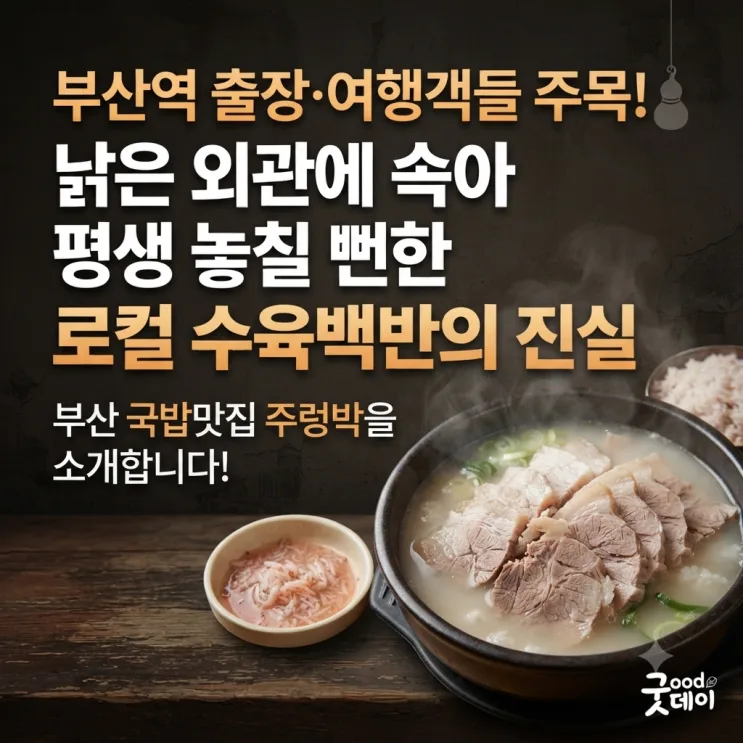
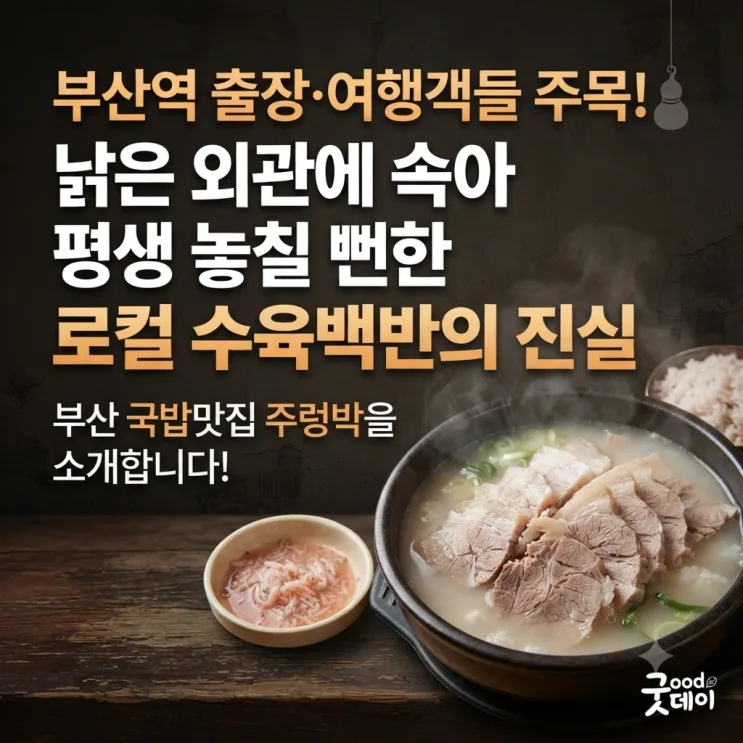
Tucked into the alley behind Busan Chinatown — near the end of the alley of Three Kingdoms murals, less than two minutes from Exit 5 — Jureongbak is a modern gukbap house that has quickly built a base of local office-worker regulars. The concept comes from the famous “cheonjikgol” style pork houses of Jeju: dark, rich broth boiled for more than 24 hours from pork bones, and thick cuts of boiled pork belly (suyuk) sliced to order on a wooden cutting board, served with a self-service station of three dipping sauces and side dishes.
What to order
- Suyuk Baekban (수육백반, 13,000 won) — the signature. A tray of thick-sliced pork belly with rice, stewed kimchi, and all the fixings. Ask them to slice it fresh at the counter; watching them work the cutting board is half the experience.
- Dwaeji Gukbap (돼지국밥, 9,000 won) — a clean, deep pork broth with plenty of tender meat. Rice refills are free, so this is the budget-maximizing order.
- Dwaeji Kalguksu (돼지칼국수, 9,000–9,500 won) — hand-cut knife noodles in pork broth, also available in a spicy “eolkeun” version. A rare find: most gukbap houses near the station do noodles this well.
Practical details
The restaurant sits at 18 Choryangjung-ro 34beon-gil, Dong-gu, roughly a 2-minute walk from Busan Station Exit 5. Hours run from late morning (around 10:30) to 22:00, with an afternoon break in the mid-afternoon (around 15:30–17:00) — check before a late-afternoon visit. There is no private parking; use the Chinatown public lot if you drive. One genuinely local touch: the house offers a steep discount to soldiers, police officers, and firefighters, and the walls are covered with celebrity autographs. Weekday lunch can mean a short wait, but turnover is fast.
2. Boksunne (복순네): A Choryang Alley Table d’Hote with a Big Heart
What it is
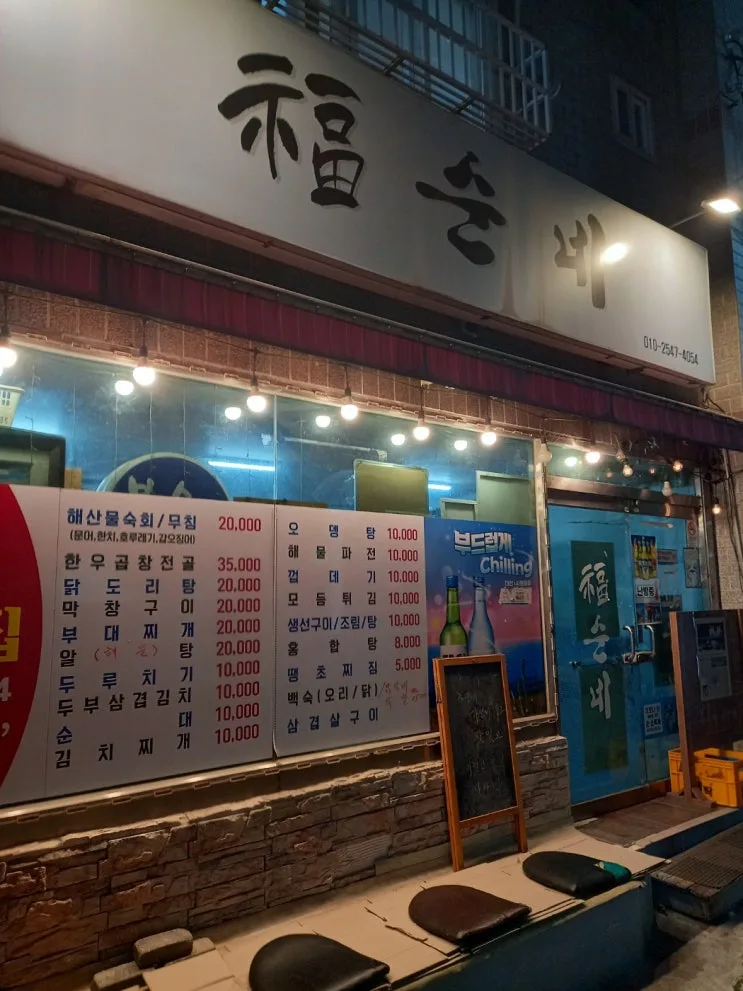
Walk eight minutes from the station into the quiet residential alleys of Choryang (Gogwan-ro 7beon-gil) and you reach Boksunne, a no-frills Korean baekban house and neighborhood tavern that most guidebooks have never heard of. The clientele is a mix of Choryang grandmothers, local artists, and office workers who treat the place like a second kitchen. The owner cooks the side dishes herself, and the portions operate on the old-school principle that nobody should leave hungry: order one stew and the complimentary side dishes alone arrive like a second meal.
What to order
- Duruchigi (두루치기) — a boldly seasoned, stir-fried pork and vegetable dish that sits between a bulgogi and a kimchi stew; the house specialty and the reason the regulars come back weekly.
- Kimchi-jjigae (김치찌개) — sour kimchi, pork, and tofu in a fiery, honest broth. Perfect on a cold Busan morning or after a late train.
- Dakdoritang (닭도리탕) — when available, a giant braised whole chicken in a kimchi-spiked sauce that easily feeds three people for around 20,000 won.
Practical details
Boksunne is a single-floor, ten-table room where a lunch of stew plus rice rarely exceeds 10,000 won per person, and a dinner with drinks stays well below what you would pay near the station’s hotel strip. Service is generous — expect a small complimentary dish to appear “by the owner’s heart,” as locals say. It works equally well as a lunch stop and as a first-night soju tavern. Note that it is a true local spot: English is minimal, so point at the menu board or show this paragraph.
3. Choryang Milmyeon (초량밀면): The Station’s Signature Cold Noodles
What it is
Directly across the main road from Busan Station square (225 Jungang-daero, about 5 minutes from the exits), Choryang Milmyeon is the representative milmyeon house of the station area — the home branch of a small group whose other stores are in Haeundae and Mipo. Milmyeon is Busan’s own noodle dish, born from wheat flour supplies left after the Korean War, and this is one of the easiest places in the city for a first-timer to understand what the fuss is about.
What to order
- Mul Milmyeon (물밀면, 7,000 won small / 8,000 won large) — chilled wheat noodles in an icy pork-bone broth simmered for 48 hours with medicinal herbs like licorice and cinnamon. The bowl arrives with slush on top; drink the broth first, then loosen the spicy gochujang paste gradually rather than stirring it all in at once.
- Bibim Milmyeon (비빔밀면, same prices) — the spicy mixed version, sweet-hot and nutty with crushed peanut, ideal in summer.
- Wang Mandu (왕만두, 7,000 won) — six enormous steamed dumplings with thin skins and juicy pork-chive filling. Regulars insist the dumplings are as famous as the noodles; do not skip them.
- Gun Mandu (군만두, 5,000 won) — the pan-fried version, if your group is split.
Practical details
Hours are 10:00–21:30 daily, last order 21:00, with no afternoon break. Crucially for arriving travelers, the entrance has a dedicated luggage storage corner, and the tables are spaced widely enough for suitcases. The rotation is very fast, so even a lunchtime queue of ten groups usually clears in 15–20 minutes. There is a kettle of warm broth on every table for the winter months, and the side dishes (radish kimchi, cucumber salad) and water are self-service.
4. Shin Pawyuen and Maga Mandu (신발원·마가만두): The Chinatown Dumpling Rivals
What it is
Busan’s Chinatown, directly across from the station, is famous above all for mandu (dumplings), and the scene is dominated by two old rivals a one-minute walk apart. Shin Pawyuen, founded in 1952, is the 70-year-old grand institution at the entrance of the Chinatown gate alley; Maga Mandu, slightly deeper into the neighborhood, is the townie favorite with thicker, chewier skins and an explosive juice content. Trying one (or, honestly, both) is the cheapest food culture lesson you can buy within sight of Busan Station.
What to order
- At Shin Pawyuen: gun mandu (군만두, around 5,300–6,000 won) — fried to order, shatteringly crisp outside and dense with pork and chive inside. The goon-sae set (one steamed pork dumpling, one fried dumpling, one shrimp dumpling, two pieces each, about 10,000 won) is the easiest way to sample everything. Steamed Busan mandu (around 5,600 won) showcases the thin fermented skin. The takeout annex next door has a kiosk for takeout in about 12 minutes, and the main hall also sells Chinese pastries like wolbyeok (moon-style cakes, 3,500 won) and twisted dough (kkwabaegi, 2,000 won).
- At Maga Mandu: the steamed dumplings (around 8,000 won for seven) have a dim-sum-level juice content and a gentle ginger-garlic spice; the fried version (about 8,000 won) has a thicker, chewier skin than Shin Pawyuen’s. Order by phone ahead or ask for takeout at the counter to skip the line entirely — takeout stacks move fast here.
Practical details
Shin Pawyuen’s main hall runs roughly 11:00–20:00 and closes Tuesdays; its takeout annex keeps different hours and closes Wednesdays, so double-check the sign on the door. Maga Mandu runs about 11:00–21:00 with a 15:00–16:00 break and its own closing day (check the day’s notice). Both are a 1–2 minute walk from Busan Station Exit 5, inside the Chinatown gate. If you want dumplings for your hotel room or your train ride, takeout at Shin Pawyuen’s annex is the smoothest option — order at the kiosk, walk the Chinatown mural street while you wait, and collect a hot box.
Quick Comparison: Which One Is Right for You?
| Restaurant | Where / Nearest Exit | Signature Order | Price per Person | Luggage Friendly | Waiting Level |
|---|---|---|---|---|---|
| Jureongbak (주렁박) | Chinatown back alley / Exit 5, ~2 min | Suyuk baekban (13,000) or dwaeji gukbap (9,000) | 9,000–13,000 won | Aisle tables; snug but possible | Short wait at weekday lunch only |
| Boksunne (복순네) | Choryang residential alley / ~8 min walk | Duruchigi; kimchi-jjigae | 7,000–12,000 won (dinner with drinks ~15,000) | Narrow alley; better after dropping bags | Almost none — locals’ secret |
| Choryang Milmyeon (초량밀면) | Station frontage road / ~5 min | Mul milmyeon (7,000) + wang mandu (7,000) | 7,000–15,000 won | Yes — dedicated luggage corner at the entrance | 15–20 min at peak; near zero before 10:30 |
| Shin Pawyuen / Maga Mandu | Chinatown gate / Exit 5, 1–2 min | Gun mandu (~5,300) / steamed mandu (~8,000) | 5,000–10,000 won | Takeout annex is ideal for suitcases | Shin Pawyuen queues longest; takeout skips the line |
Local Insider Tips Before You Go
Where to store your luggage
Busan Station has coin lockers of several sizes throughout the concourse, and there are private luggage storage counters around the station square and inside Choryang Milmyeon itself. The most efficient route: arrive, drop the suitcase in a locker on the way out of the gates, then eat with both hands free. If your hotel is in the station area, asking the hotel to hold the bags beats any locker for price.
How to beat the peak hours
These blocks run on one rhythm: the KTX timetable. Trains from Seoul unload in waves, and the lunch peak between roughly 11:30 and 13:30 is when every queue forms. Arrive before 10:30 (Choryang Milmyeon and Jureongbak open late morning) or after 14:00 and you will usually walk straight in. For dinner, the reverse applies — the station area empties after 20:00, and Jureongbak keeps serving until 22:00 for late arrivals.
Eating with a child
All four places are relaxed about children, which is one of the quiet strengths of eating in Choryang rather than in a sit-down tourist restaurant. Choryang Milmyeon is the easiest with a stroller — wide aisles, spacious tables, mild broth noodles, and dumplings a toddler can hold. At Jureongbak, the gukbap with free rice refills makes a soft, mild meal for kids (order the broth with less pepper). Boksunne’s stews can be made milder if you ask when ordering. Only caution: the fried dumplings at Shin Pawyuen and Maga Mandu come out extremely hot — give them two minutes before handing one to a small child.
Frequently Asked Questions
Is Busan Station a good area for food, or should I go to Haeundae or Gwangalli?
For value and authenticity, the station area beats both. Haeundae and Gwangalli are beach districts where you pay for the view; Choryang and Chinatown are where Busan locals eat lunch every day, at prices that have barely moved in a decade. If your schedule allows only one meal near the station before moving on, make it one of the four above rather than a restaurant inside the station building.
Can I handle these restaurants without speaking Korean?
Yes. Choryang Milmyeon has a short, picture-friendly menu and self-service sides; Shin Pawyuen’s annex has a kiosk with photos. At Jureongbak and Boksunne, simply show the staff the dish names above — suyuk baekban (수육백반), dwaeji gukbap (돼지국밥), duruchigi (두루치기) — and they will take it from there. Card payments are accepted everywhere; cash is not needed.
How much should I budget for a meal here?
5,000–10,000 won per person covers a full lunch at any of the four (a bowl of milmyeon plus dumplings is about 14,000 won for two people to share generously). Only Jureongbak’s large suyuk platters (25,000–39,000 won) push the bill higher, and those are designed for groups of three or more.
Are these places open year-round, including holidays?
Choryang Milmyeon and Jureongbak open daily with no regular closing day; the dumpling houses each close one weekday (Tuesday for Shin Pawyuen’s main hall, midweek for the others) and can also close on Seollal or Chuseok itself. Hours and closing days do shift with the seasons, so a quick check of the shop’s notice — or a map app — on the morning of your visit is the local habit worth copying.
Final Thoughts: Eat Where the Station Workers Eat
Busan Station’s surroundings have a reputation, fairly or not, as a place you pass through. Spend one lunch hour on the Choryang side of the tracks and the reputation falls apart: within five minutes of your train door there is a 24-hour-broth gukbap house with a wooden cutting board, an alley baekban kitchen that has fed local artists for decades, a milmyeon institution with a luggage corner for travelers, and two dumpling shops that have argued over the same alley since 1952. Start with the comparison table above, drop your bag in a locker, and pick the one that matches your mood — then come back for the others on your way home. That is exactly what the regulars do.